Kimberly McNair Brock grew up only knowing her sister, Denise, through photographs.
Her sister, Denise McNair, was one of four girls killed in the bombing of Sixteenth Street Baptist Church on September 15, 1963. But for Brock, who was born five years after her sister died, Denise is much more than a name read aloud. She was the sister she was never able to know, whose life existed only in her family’s memories.
“They did not talk about Denise very much,” Brock said about her parents. “There were photographs of her around the house, and her presence was part of our family’s surroundings. My parents kept a couple of chests in the garage filled with Denise’s clothes and toys. My sister Lisa and I didn’t know what was inside them; I only knew they belonged to Denise.”
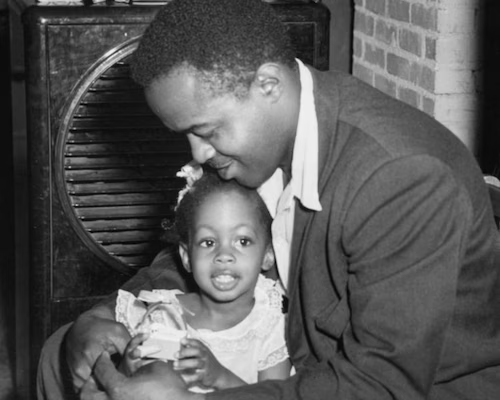
Denise McNair and her father, Chris McNair. (Courtesy of McNair family)
Her parents rarely talked about the daughter they had lost, the pain being too great. Brock would ask questions, sometimes simple yes-or-no questions, trying to understand the sister she never had the chance to know, but when the questions became more difficult, her parents would shut down.
Then, when Brock was about 8 years old, her grandmother called her and Lisa into the living room after church. She had something to show them. Inside a box were small remnants of a precious little girl’s life: Denise’s coin purse, a handkerchief, and her patent-leather shoes. There was also something Brock had never expected to see: the rock that had been embedded in Denise’s head when she was killed.
Until then, Denise had been a presence in photographs and family stories. That afternoon, the year 1963 came into focus.
More than six decades later, Brock still thinks about the girl behind the name that has become so familiar to the world. Before Denise McNair became one of the four children remembered every September at Sixteenth Street Baptist Church, she was simply Denise. A daughter, a sister, a friend, a little girl with a personality all her own.
“She was somebody special,” Brock said. “A lovable person, sassy. I know she lived out her time here to the fullest.”
Denise was also someone who noticed people who were being left out. She organized a fundraiser for muscular dystrophy, and when a girl in one of her clubs could not afford her dues and was going to be excluded, Denise paid them for her. Brock remembers her as a champion for the underdog, someone who seemed instinctively aware of the people around her who needed a little help.
It is the Denise her family remembers—not only the 11-year-old girl who was killed, but the person she was becoming. And that distinction matters as Sixteenth Street Baptist Church begins a new chapter in telling its story.
On Sept. 15, 2026, the church marked the 63rd anniversary of the bombing with its annual memorial service and opened the new Sixteenth Street Baptist Church Education & Visitor Center, a space next to the historic sanctuary designed to give visitors opportunities to learn about the church’s history while considering what that history asks of them now. Because for the families of those four little girls, the history is something they’ve carried heavily, in their hearts, for 63 years.
The weight of memory
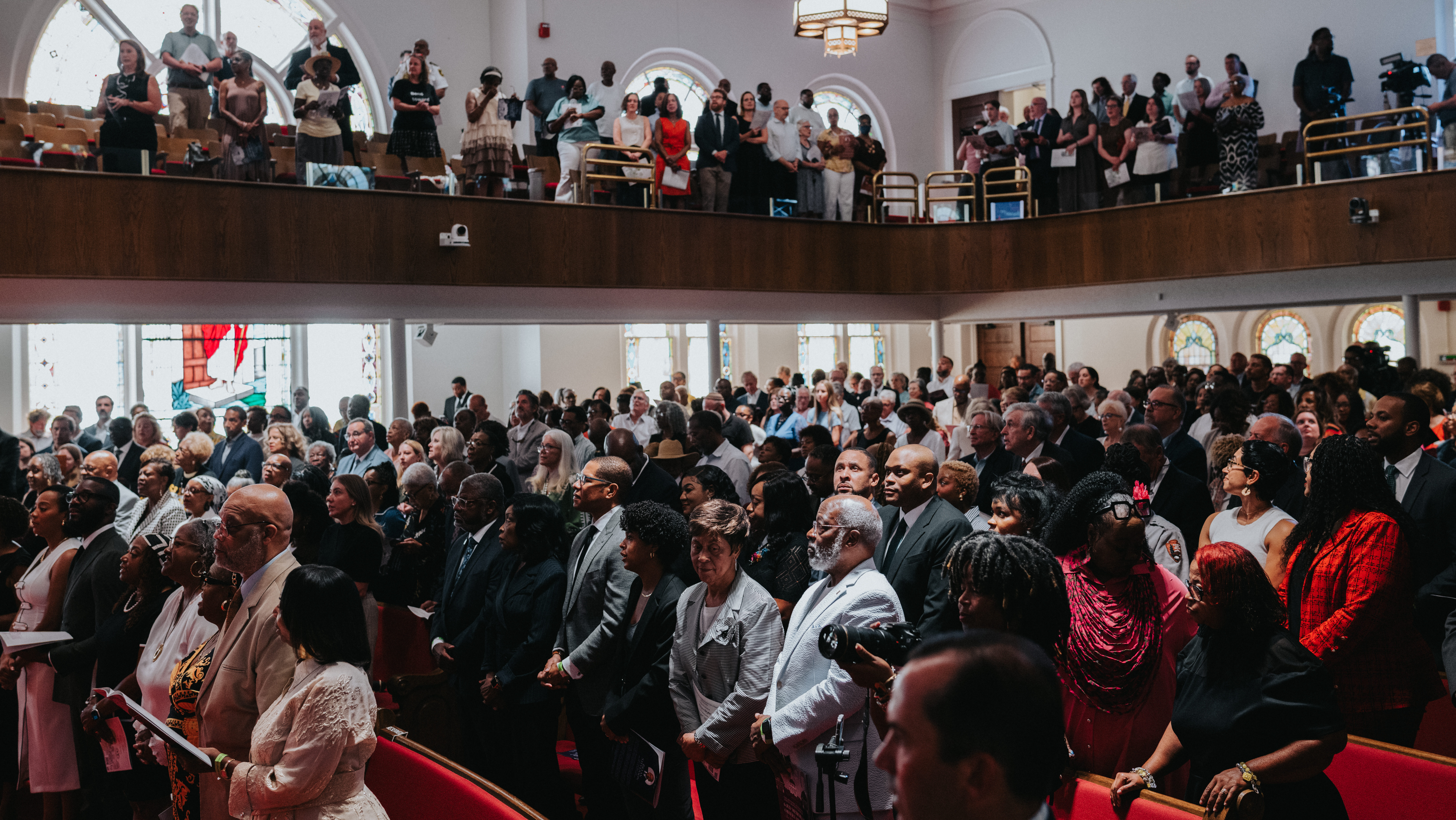
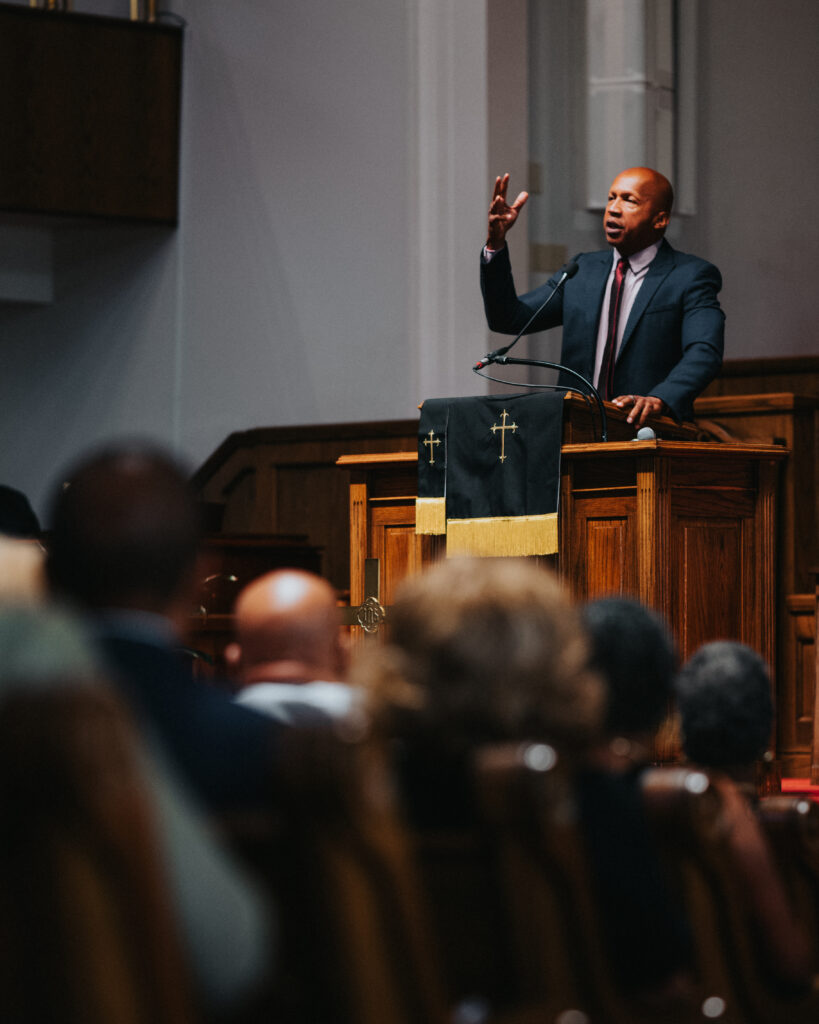
The morning the Education & Visitor Center opened, Brock sat in the church sanctuary as Bryan Stevenson spoke from the pulpit.
(Mason David Erwin/SoulGrown)
Stevenson, founder of the Equal Justice Initiative, began by acknowledging the families of the four children. Then he told a story about his grandmother, who had been born to people who had been enslaved and spent her life working as a domestic. When Stevenson was a child entering a newly integrated world, she did not know how to prepare him for what was coming because she had never lived through that experience herself. What she did know how to do was embrace him.
She would squeeze him tightly and, an hour later, ask, “Bryan, do you still feel me hugging you?”
Years later, when she was dying, she asked him the same question. She told him she would always be hugging him.
Standing inside Sixteenth Street Baptist Church, Stevenson connected that memory to the four girls whose lives were taken there. Denise McNair, Addie Mae Collins, Carole Robertson, and Cynthia Wesley. He asked those gathered to allow the spirit of the children to embrace them.
“Their needless deaths have power,” he said.
For Stevenson, the story of Sixteenth Street is also a story about what generations choose to do with the suffering handed down to them. He spoke about his own complicated questions about American identity, the history of slavery and racial violence, and the ways those histories continued to shape his own life. But he also spoke about the millions of formerly enslaved people who, after emancipation, chose to build schools, families and communities rather than surrender themselves to revenge.
He spoke about the people of Sixteenth Street who, after the bombing, remained grounded in their faith. They could have given themselves over to hatred, he said, but instead they continued to build and to believe.
Then he offered a metaphor for the generations gathered in the sanctuary: The people who came before us have finished their race. They have handed us the baton.
Now it is ours to carry.
From remembrance to action
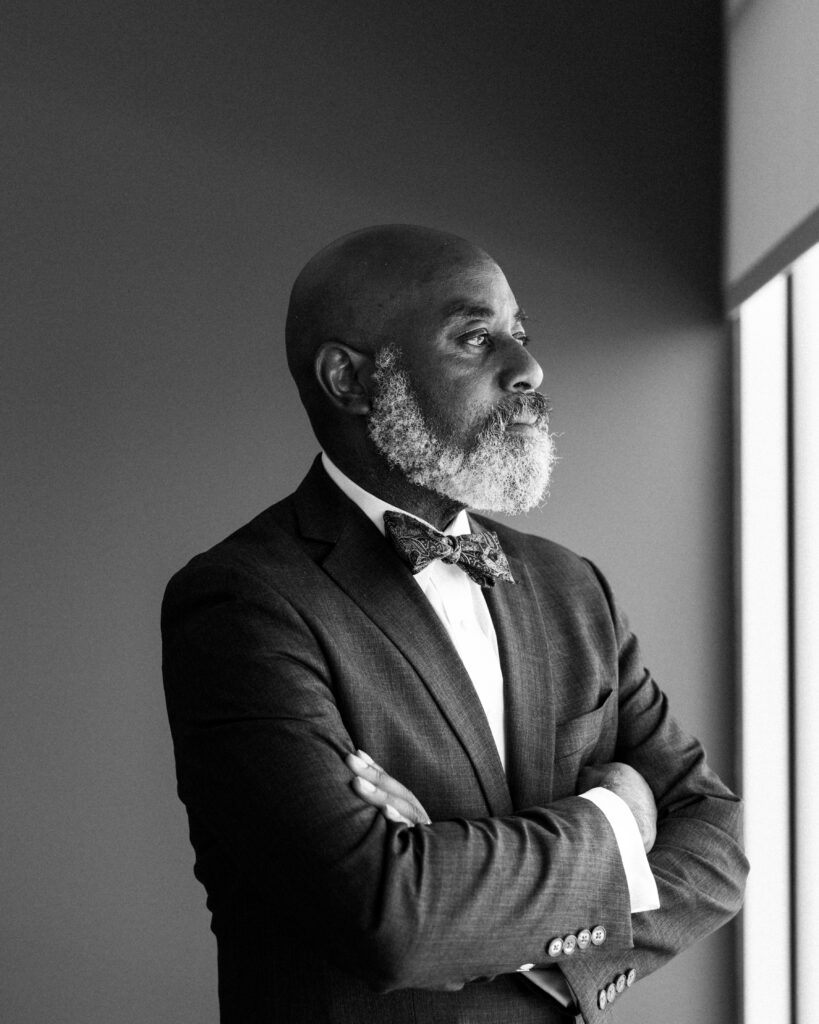
That idea sits at the heart of the new Education & Visitor Center. For Dr. Terrence Brown, the Center’s executive director, opening day was the realization of a dream that had taken years to build. But when he looked around the crowd, he wasn’t simply thinking about the people who had come to witness the opening.
(Mason David Erwin/Contributed)
“I saw people from all walks of life,” Brown says. “To bear witness. That means everything, but now we have to move from that remembrance into action.”
The Center is intended to provide visitors with opportunities for reflection, education and engagement through oral histories, speaker programs, artist residencies, community projects and other experiences that connect the history of Sixteenth Street Baptist Church to questions that remain relevant today.
One of Brown’s favorite programs is the quilting project. Several sewing machines will be available in the Center, allowing people to sit together and create quilts that will ultimately be given to children in foster care. He calls it the “Quilt of Many Hands.”
The idea is simple: people sit around a table, each contributing a stitch to something that will eventually belong to a child who may move from home to home carrying their belongings in little more than a plastic bag.
But he also acknowledges that something bigger happens around the table. “There is nothing more special when a group of people quilt together,” he says. “That’s community.”
Someone may share their whole life story. Someone else may reveal only a small piece of themselves. Either way, people leave knowing something they did not know before. “I may be Republican, Democrat, or whatever label you want to slap on me,” Brown says. “But when I’m at that table, I’m fully human.”
That, he says, is what has to be stripped away if people are going to create change.
The Center is designed to create those opportunities for connection in a number of ways. Its spaces include areas for reflection and creative projects, gathering rooms, oral history initiatives and programs designed to bring people together around shared experiences. The Center also includes Koinonia, a restaurant and gathering place built around the idea that fellowship and conversation can happen around a shared table.
For those who prefer reflection to conversation, Brown has another idea: Visitors can write a letter to the next generation. “There are many ways to participate,” he says.
The ripple
(Joshua Jackson and Kelby Dillard/Contributed)
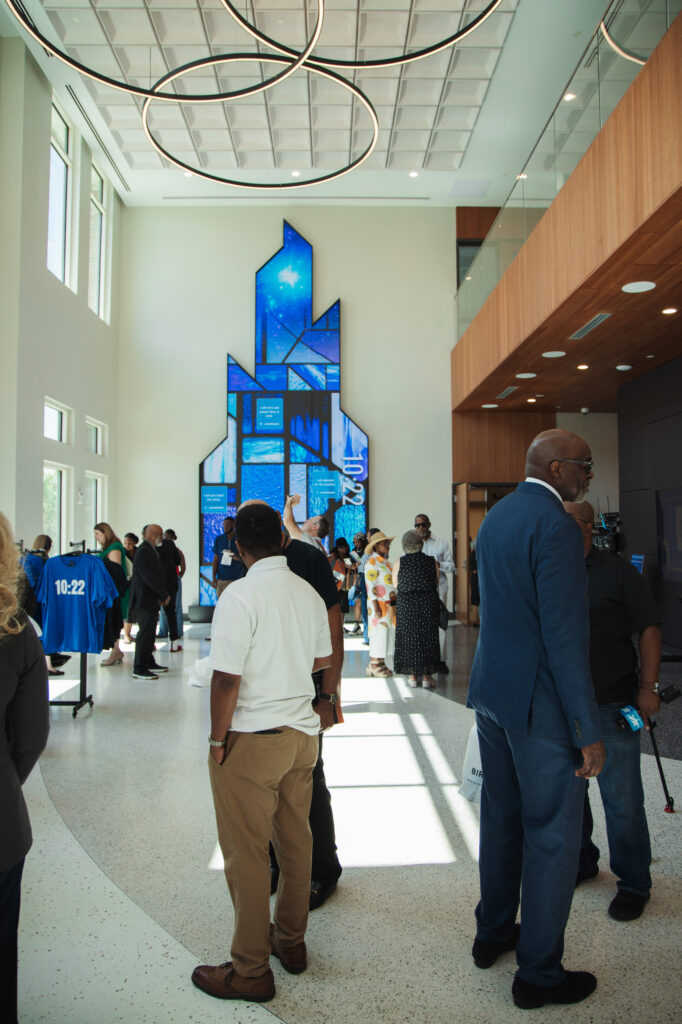
One of the Center’s signature installations is The River Wall, an immersive exhibit inspired by the church’s stained-glass windows. The exhibit is designed to invite visitors to reflect on what they have experienced and consider personal commitments connected to faith, justice and reconciliation.
Throughout the Center, the emphasis is not simply on what happened in Birmingham in 1963, but on what people do after learning about it. Visitors are invited to listen, create, write, gather and consider the ways their own lives intersect with the larger history of the city and the country.
It is also a reminder that the people remembered at Sixteenth Street were not abstract symbols. They were children.
Brock wants that distinction to remain central as the Center evolves. She hopes it will become a place of education not only for tourists who come to Birmingham to learn about the Civil Rights Movement, but for Birmingham children who may grow up without knowing what happened inside the church. She hopes curriculum can be built around the history, and she hopes that whatever the Center becomes over the coming decades, it always remains connected to the four girls whose lives were taken.
Because without them, none of this would exist.
“We don’t know what each girl would have been,” Brock says. “What they would have done with their lives.”
She can imagine Denise, though. Brock believes her sister would have cared deeply about what was happening in the country. She would have been concerned with equal rights. She would have helped people. And she certainly would have kept looking out for the underdog.
What we carry
Before the ribbon was cut, Rev. Arthur Price Jr., pastor of Sixteenth Street Baptist Church, spoke about what he hopes the new Center will become.
“Love never fails,” he said, quoting scripture as he began to speak.
He described the Center as a place where people can come together in a spirit of love and community, but also as a place to activate something people often lose: imagination. To imagine what the world can be, he said, people first have to grapple with their history.
For Brock, though, the most important part of that inheritance remains deeply personal. She is still the sister whose coin purse and patent-leather shoes were kept by her grandmother. She is still the girl who paid another child’s dues because she did not want her to be left out. She is still the daughter her parents never stopped carrying.
And she is still the sister Brock wishes she could know.
I asked Brock if she could sit down with Denise today, what would she say to her?
“I would ask more I would tell,” Brock said. “I would ask about our family, about our parents, who they were before this tragedy happened.”
And what would she want people to carry with them after learning about what happened at Sixteenth Street Baptist Church?
“I want people to remember that, at the end of the day, this is about the four girls. There would be no Center, no memorial, no reason for any of us to be having these conversations if Denise, Addie Mae, Carole, and Cynthia had not lost their lives that day. I hope we never lose sight of them. They’re not just symbols; they were little girls. They had families, personalities, dreams and futures. Their lives mattered then, and their memories deserve to be honored with care, dignity, and respect now.”