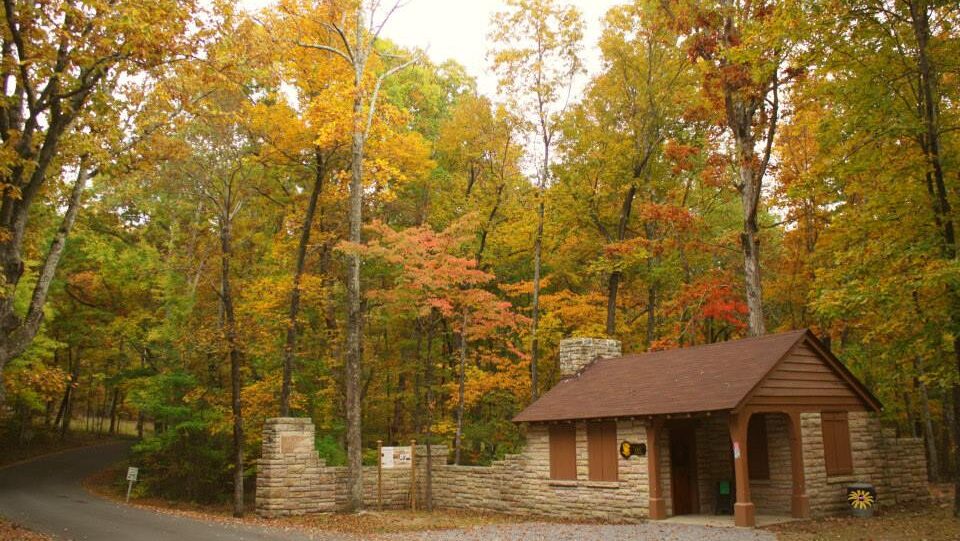
Perched atop Lookout Mountain in DeKalb County, the small town of Mentone is known today for its waterfalls, cool mountain air, historic inns, summer camps, and unhurried charm. Yet the town’s history extends well beyond its present reputation as an Alabama getaway.
Long before Mentone was incorporated, the land had already witnessed centuries of habitation and history—some of it documented fact, some of it the stuff of Alabama folklore.
Before There Was a Mentone
The area around present-day Mentone was home to the Cherokee Nation prior to European settlement. In 1782, a skirmish between Chickamauga Cherokee forces and frontier settlers took place nearby, adding another layer to a landscape that had already been inhabited and traversed for generations.
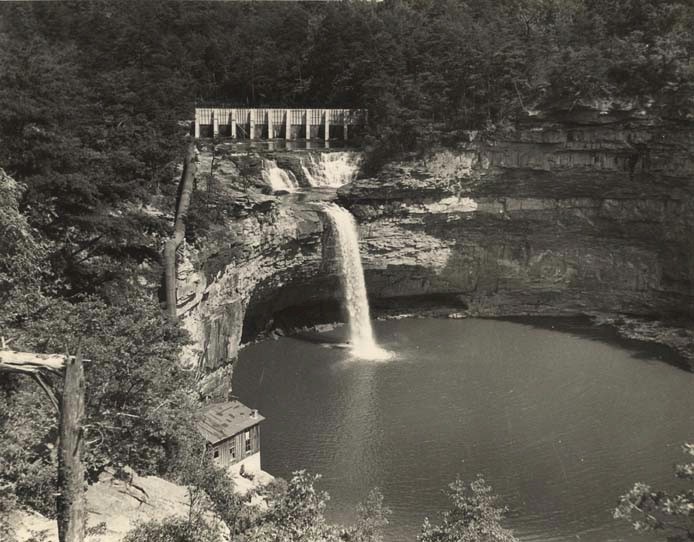
More than two centuries earlier, another notable figure had passed through the region. In 1540, the expedition of Spanish explorer Hernando de Soto traveled through what is now Alabama and is believed to have camped near present-day DeSoto Falls while searching for gold. The waterfall, now part of DeSoto State Park, still bears his name.
And then there is the story that has proven far more difficult to lay to rest.
The Legend of Prince Madoc
According to a centuries-old Welsh legend, Prince Madoc—or Madog ab Owain Gwynedd—sailed west from Wales around 1170 with a group of followers in search of a new home.
The story has taken many forms over the centuries, but one version places Madoc’s landing on the Alabama coast near present-day Fort Morgan. From there, the Welsh settlers are said to have traveled inland along Alabama’s river systems, eventually reaching Lookout Mountain and the area around present-day Mentone. The legend continues that conflict with Native American tribes ultimately forced the group farther north, first toward Kentucky and later into the upper Missouri River valley.
There remains, however, an important distinction between the legend and the historical record. The Madoc story first appeared in written form in the sixteenth century, centuries after the voyage it purports to describe. Historians and professional archaeologists overwhelmingly reject the notion that a Welsh colony arrived in North America under Madoc’s leadership. The Encyclopedia of Alabama characterizes the account as highly implausible, noting that later versions of the legend were employed, in part, to bolster English territorial claims in the Americas.
Even so, the legend found a particularly enduring home in Alabama.
The Welsh Caves
(DeSoto State Park~Fort Payne, Alabama/Facebook)
Near DeSoto Falls lie a series of formations known as the Welsh Caves, which became woven into the Madoc narrative over time. Proponents of the legend have claimed the caves contain evidence of Welsh settlement. Alabama State Parks has documented both the caves and the surrounding folklore, while also noting the area’s association with Native American use.
The caves remain a significant piece of local legend, but they do not constitute proof of a medieval Welsh settlement. The Encyclopedia of Alabama reiterates that professional scholars reject the possibility of a pre-Columbian Welsh presence in the region.
This scholarly consensus has not diminished the story’s cultural staying power. Alabama State Parks continues to include the Welsh Caves among the narratives explored in its “Legends on the Lookout” series, alongside the histories of DeSoto State Park, DeSoto Falls, and the Civilian Conservation Corps.
Sometimes a legend endures not because it has been proven, but because it continues to be told.
How Mentone Became Mentone
The documented history of the town begins considerably later. Around 1854, the area was known as Ellison’s Precinct, named for a local grist-mill operator. The first settler’s home, built around this time, would eventually become the nucleus of St. Joseph’s-on-the-Mountain Episcopal Church.
Mentone itself emerged later in the nineteenth century. The community was founded by John Mason, and in 1884 his daughter, Alice, gave it the name Mentone—inspired by Menton, France. The name has since been associated with the phrase “musical mountain spring,” a fitting description for a place whose natural springs would soon shape its development.
Those springs proved to be more than a scenic feature. During the late nineteenth and early twentieth centuries, visitors traveled to Mentone seeking the reputed healing properties of its mineral waters. The town grew into a summer resort, with hotels and other accommodations built to welcome those escaping the heat of the lowlands. The Mentone Springs Hotel, completed in 1884, became one of the town’s most recognizable landmarks and drew thousands of summer visitors before burning in 2014.
A Mountain Retreat Takes Shape
(DeSoto State Park/Facebook)
Mentone’s identity as a summer destination persisted well after the popularity of its mineral springs began to wane. The town became known for its camps, lodges, and historic accommodations, forming the seasonal community that continues to define much of Mentone today. Camp Juliette Low, established in 1920 and named for the founder of the Girl Scouts of America, was among the earliest youth summer camps in the region.
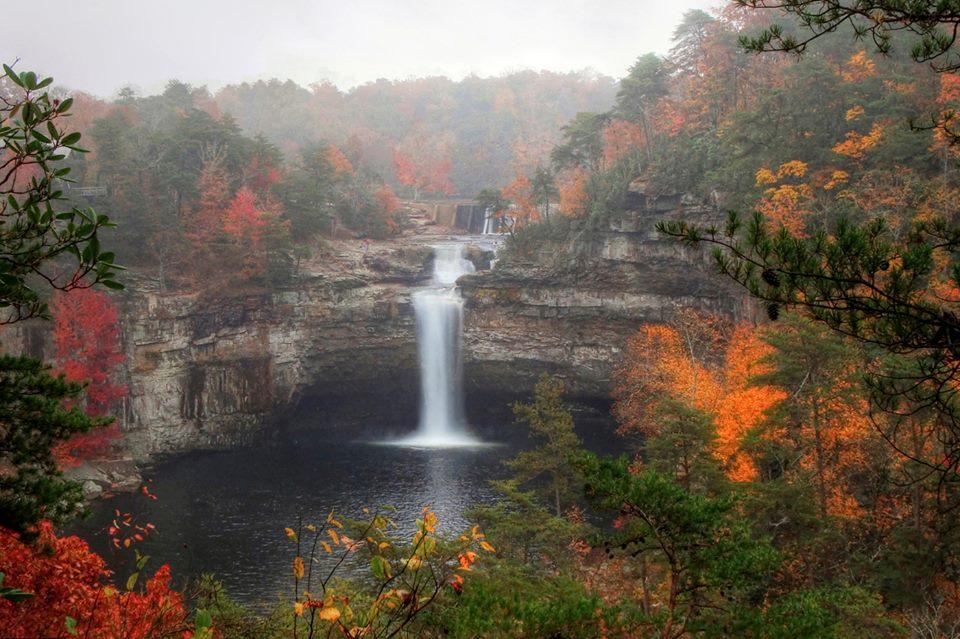
Mentone was incorporated in 1935 and continued to develop as a destination for those drawn to the scenery of Lookout Mountain. Today, the springs that once drew visitors in search of healing waters are no longer central to the town’s identity — some remain, while another was lost during the construction of Alabama State Highway 117 — but the landscape that first established Mentone as a resort town endures. DeSoto Falls remains among Alabama’s most visited waterfalls, while nearby DeSoto State Park continues to offer hiking, camping, fishing, swimming, and other means of experiencing the mountain.
What Remains
What makes Mentone especially compelling may not be any single story, but rather the accumulation of narratives layered onto the same landscape: the documented history of the Cherokee people who lived here, the passage of de Soto’s expedition, the settlement of the area in the nineteenth century, the rise of the mineral springs, and the resort era that followed.
Civil War history is also part of this record. During the Chickamauga Campaign, thousands of federal soldiers camped on nearby Lookout Mountain, and Civil War artifacts have since been recovered in the area around Mentone.
And then, tucked among all of it, is Prince Madoc. The Welsh prince almost certainly never stood beneath DeSoto Falls, and no reliable archaeological evidence supports the presence of a Welsh colony in Alabama. Yet the legend has nonetheless become part of the cultural fabric of this mountain town.
Mentone’s history doesn’t need the legend to be worth telling. Perhaps that’s the point of it, though: that a landscape already carrying the weight of mountains, caves, waterfalls, and generations of passing settlers still has room for a story that won’t quite let itself be forgotten.
Love this story? Subscribe to our newsletter and get the best of Alabama delivered to your inbox every Friday.