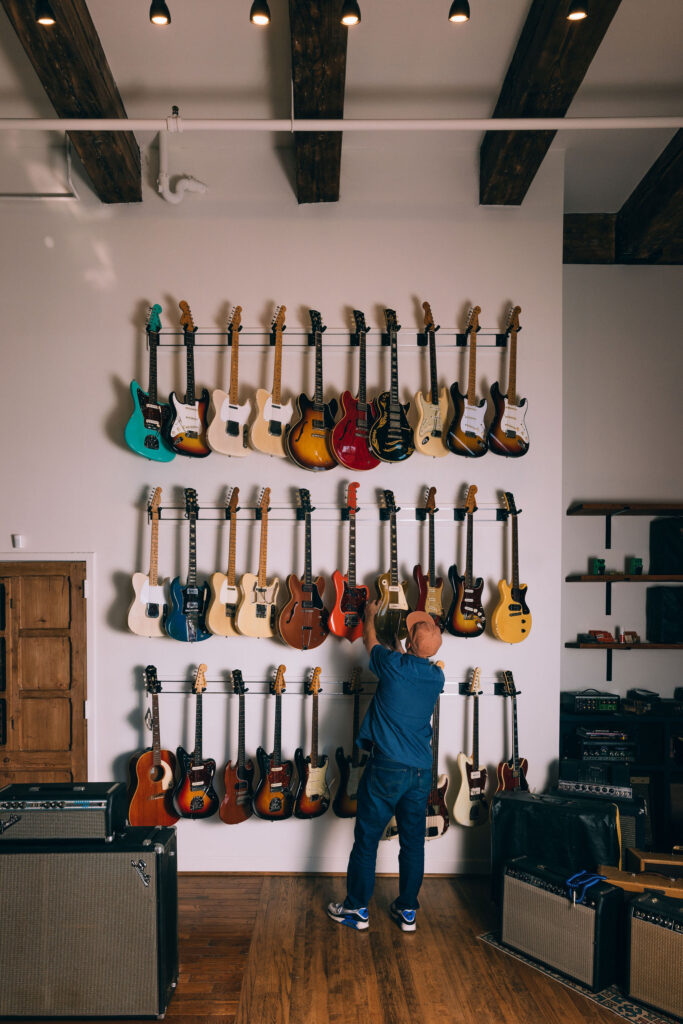
In a corner studio on Morris Avenue, sunlight pours in through floor to ceiling windows to showcase a wall full of vintage guitars curated by John Shults, guitar enthusiast and owner of True Vintage Guitar.
For sixteen years, Shults has been helping people appraise, buy, and sell guitars all over the world. But his interest and passion for vintage guitars goes back even further. “If you had asked five-year-old me what I wanted to be when I grew up, I would have told you that I wanted to be an archeologist,” said Shults. “That probably came from something I had seen or been exposed to, but my obsession with the guitar was something that was just there from the beginning. I remember seeing people playing guitar and enjoying the music, but the guitar itself captivated me in a way that nothing else really did.”
From Curiosity to Curator

(Mason David Erwin/SoulGrown)
Old things have always gnawed at Shults’ curiosity. Shults says he doesn’t remember when he first peered down the rabbit hole of vintage guitars, but that he does remember thinking that they were so special that he’d probably never have the chance to own one. His summer and part-time jobs early in his college career provided a little money that he knew he could stretch if he worked hard enough to find the right one. And when his interest shifted to other guitars once the newness of that purchase wore off, he would sell it and scratch the itch with a different vintage guitar.
That cycle continued for about five years, until his obsessive brain wouldn’t let him focus on much else. Shults’ wife gave him the permission and privilege of going full time and starting True Vintage Guitar to help sellers get their prized vintage guitars back into the hands of musicians without the work, time, and risk of selling a high-end vintage guitar online. Now, touring his studio feels like a walk through an art gallery, guided by someone who is just as eager to share his passion as he is knowledge about his craft.
His Favorite Guitar: The 1959 Gibson Les Paul Standard
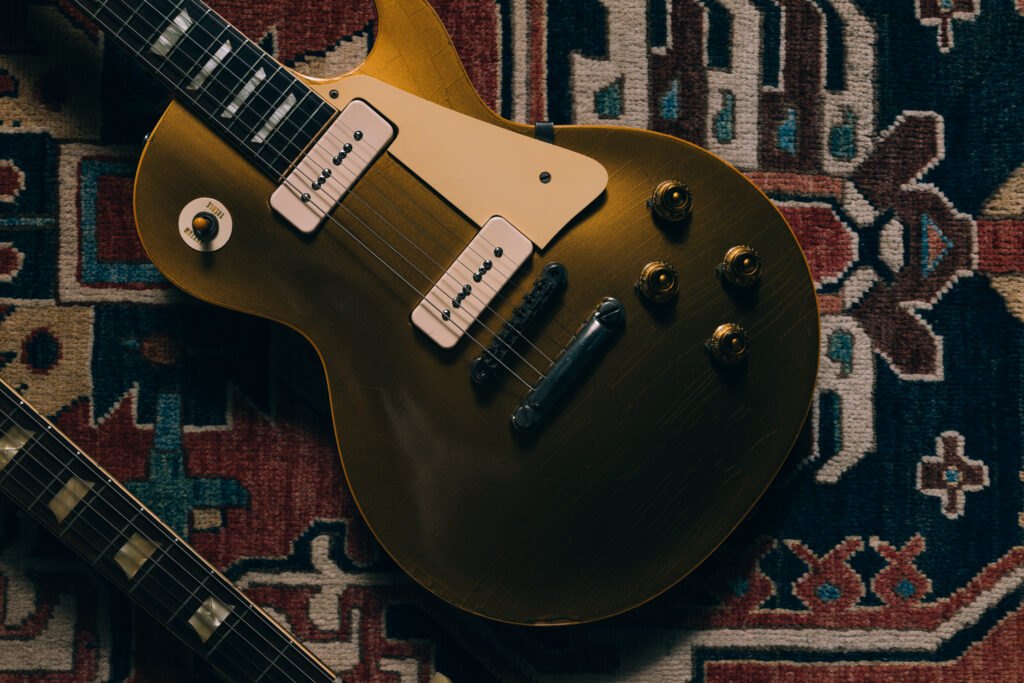
When asked about his favorite guitar he has bought and sold, Shults said, “There are so many that it’s difficult to pick just one, but the 1959 Gibson Les Paul Standard I bought outside of Houston, Texas, this past May was truly the guitar of my dreams.” He bought it from the daughter of the man who had owned it since the 1960s.
The Gibson Les Paul Standard guitars made in the 1950s are among some of the finest electric guitars ever made, but to Shults, 1959 is the best year of them all. “I was so thrilled to have the privilege of evaluating it and making an offer that turned out to be more than ten times what she had been offered previously.”
(Mason David Erwin/SoulGrown)
The craftmanship, quality, and condition of the guitar left Shults starstruck. “The guitar was stunning, with its wild top figure, tastefully faded Cherry Sunburst finish, and clean condition, with no repairs or modifications of any kind,” Shults reminisces. “I’ll never forget the feeling of sitting on the plane on my way to finally buy the guitar that had driven my passion for this business for over 16 years.”
Shults’ knowledge and passion for guitars is palpable. He is a walking textbook of guitar history, his studio a museum of its art and craft. For him, it’s more than just the music the guitar can play, but the instrument itself that holds exquisite beauty and intricate details. Yet despite his depth of knowledge, conversation with Shults feels less like a history lesson and more like catching up with an old friend. His enthusiasm is infectious, and his easygoing nature makes even the most intricate details of guitar history feel like stories shared between friends.
The Guitars Heard Round the World
Shults travels so often to buy vintage guitars now that he gets to experience places he’d otherwise never get to see. “Cape Town, South Africa, and Oslo, Norway, come to mind, but my most interesting trip has to be my visit to Kuala Lumpur, Malaysia, and Singapore in February 2026.”
Much like an archeologist, Shults often travels to where the rich history of guitars meets the modern and local markets. “Fender and Gibson exported their guitars around the globe in the 1950s and 1960s, but they typically went through a local distributor in the countries they exported to,” he recounts. “Singapore was very different, since there wasn’t a local distributor there. There was a legendary music store in Singapore called TMA that imported guitars directly from Fender and Gibson.”
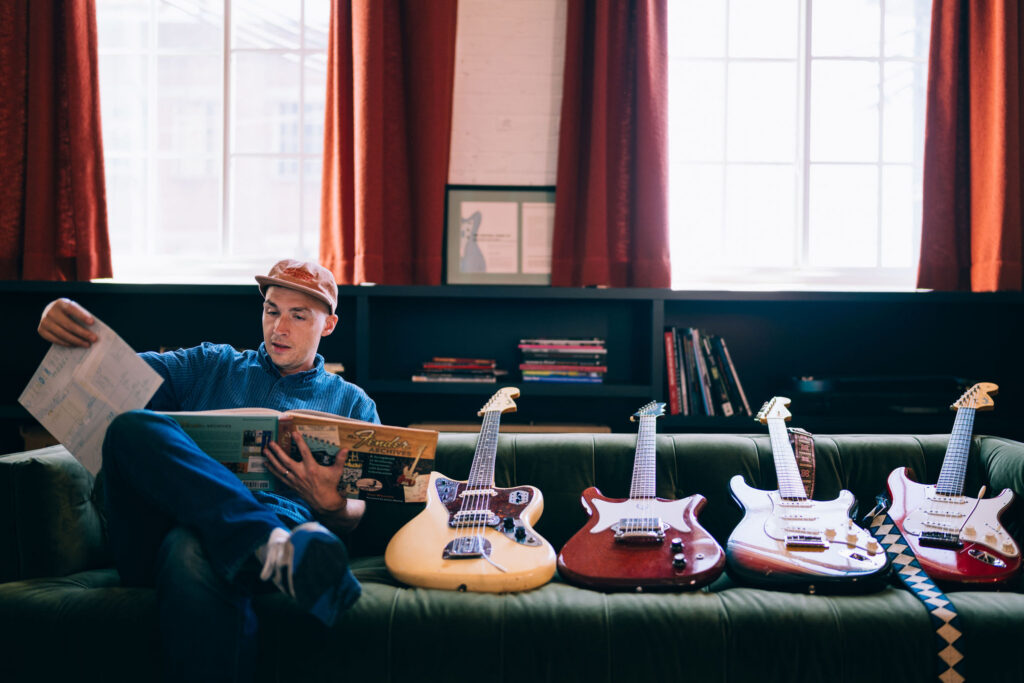
Many of those guitars have remained in the region, including a 1962 Fender Custom Telecaster, a 1960 Gibson ES-345, and a 1964 Fender Stratocaster. “I loved every minute of exploring those two countries, meeting the spectacular people, and repatriating some exceptional vintage guitars.”
(Mason David Erwin/SoulGrown)
A Lesson Learned from a Story of Failure
When asked about a favorite moment from his 16 years in business, Shults actually recalls a moment of failure. “The story that comes to mind is a great failure that taught me some of the most important lessons I carry with me when buying vintage guitars from original owners or their families.”
Sometimes guitars come to him, and sometimes Shults is the one who pursues a rare find. While scrolling through social media one day in 2013, he came across pictures of an original 1960 Gibson Les Paul Standard. A relative of the owner had posted them after the owner passed away. “I was stunned,” Shults recalls, “but as I read further, I could tell that the family didn’t appear to grasp just how special the guitar really was.”
(Mason David Erwin/SoulGrown)
It took him years to get in touch with the person who had inherited it and he was thrilled to share with them just how special the guitar actually was. But after they sold it to someone else, he realized that he hadn’t known how to be their highest level buyer. “That failure showed me what it takes to be that buyer.” Since then, he’s been able to do that for so many families, purchasing millions of dollars’ worth of the finest vintage guitars ever made.
The Appraisal Process
Shults’ curiosity and passion continues to help people on both ends of the guitar buying and selling world. His recommendation for someone who inherits a vintage guitar but isn’t a musician: Get an appraisal.
“A professional appraisal from a vintage guitar shop will give you proper identification of the instrument, an evaluation, and point out unique details that will help you research for yourself what makes your guitar special,” he says. “A paid appraisal document will help you insure your inheritance against a tragedy. Or if you’re not ready to purchase an appraisal, many shops (including mine) offer a free discussion of value options for qualifying vintage guitars. Either way, get a professional opinion first before deciding whether to keep it or sell it to a musician who’s always dreamed of owning it.”
Shults’ passion, pursuit, and preservation of these vintage guitars bridges the gap between buyers and sellers, giving old instruments and the stories they carry new life and the opportunity to be played and appreciated again.
Love this story? Subscribe to our newsletter and get the best of Alabama delivered to your inbox every Friday.