In the summer of 1860, under the cover of night, a ship slipped into Mobile Bay carrying 110 Africans. The vessel was the Clotilda—now recognized as the last known slave ship to arrive in the United States. It made its illegal voyage more than 50 years after the international slave trade had been outlawed, carrying men, women, and children who would be forced into enslavement upon arrival.
But the story of the Clotilda does not end in captivity. It continues in survival, memory, and the formation of a community that still exists today along the Mobile River: Africatown.
More than 150 years later, in 2019, the wreck of the Clotilda was officially verified at the bottom of the Mobile River. The discovery provided a physical link to a story that had long been preserved through oral history—passed down through descendants who kept alive the names, memories, and legacy of those 110 Africans.
The Clotilda: what it was, and who it carried
(Africatown Heritage House/Contributed)
The Clotilda was a schooner that became infamous not only for its illegal voyage, but for the human lives it carried from West Africa to Alabama. The 110 captured Africans came from different ethnic groups, spoke different languages, and carried distinct cultural traditions. They were taken from their homeland, transported across the Atlantic in a journey marked by violence and concealment, and delivered into enslavement in Mobile.
Their arrival in Alabama was meant to erase identity. Instead, what followed was a story of endurance.
Some of the survivors would later live into the 1920s and beyond, long enough to share firsthand accounts of their experience. Because of this, the Clotilda is now understood as one of the most fully documented accounts of the transatlantic slave trade and its final illegal chapter in the United States.
From survival to Africatown
After emancipation, the Clotilda survivors did not disperse entirely into surrounding communities. Instead, they returned to one another. Together, they established Africatown just north of Mobile in the 1880s—a self-governed community built on shared memory, language, and cultural continuity.
Africatown became more than a settlement. It was a preservation of identity. Residents maintained African traditions while building new lives as free Americans. Churches, schools, land ownership, and community institutions anchored the town, shaping a place that was both deeply rooted in Alabama and distinctly shaped by West African heritage.
It remains one of the most extraordinary examples of community formation in American history—built by people who had been taken from their homes, yet refused to lose themselves entirely.
Clotilda: The Exhibition at Africatown Heritage House
(Africatown Heritage House/Contributed)
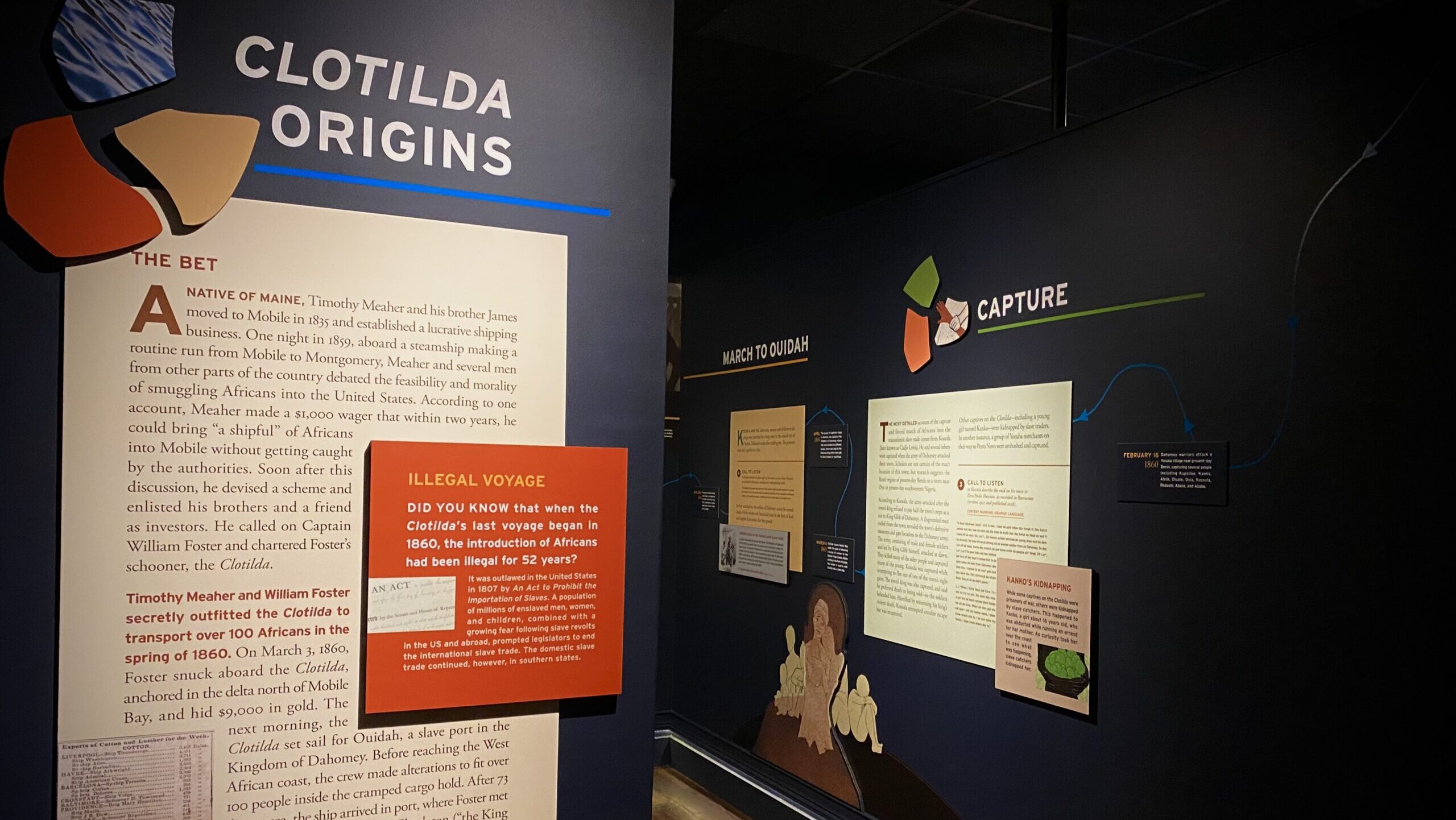
Today, the story of the Clotilda and Africatown is told in “Clotilda: The Exhibition,” housed inside Africatown Heritage House in Mobile. The exhibition occupies a 2,500-square-foot, multi-sensory space designed to center not only the history of the ship, but the lives of the 110 individuals it carried.
At its core, the exhibition is not about a vessel; it is about people.
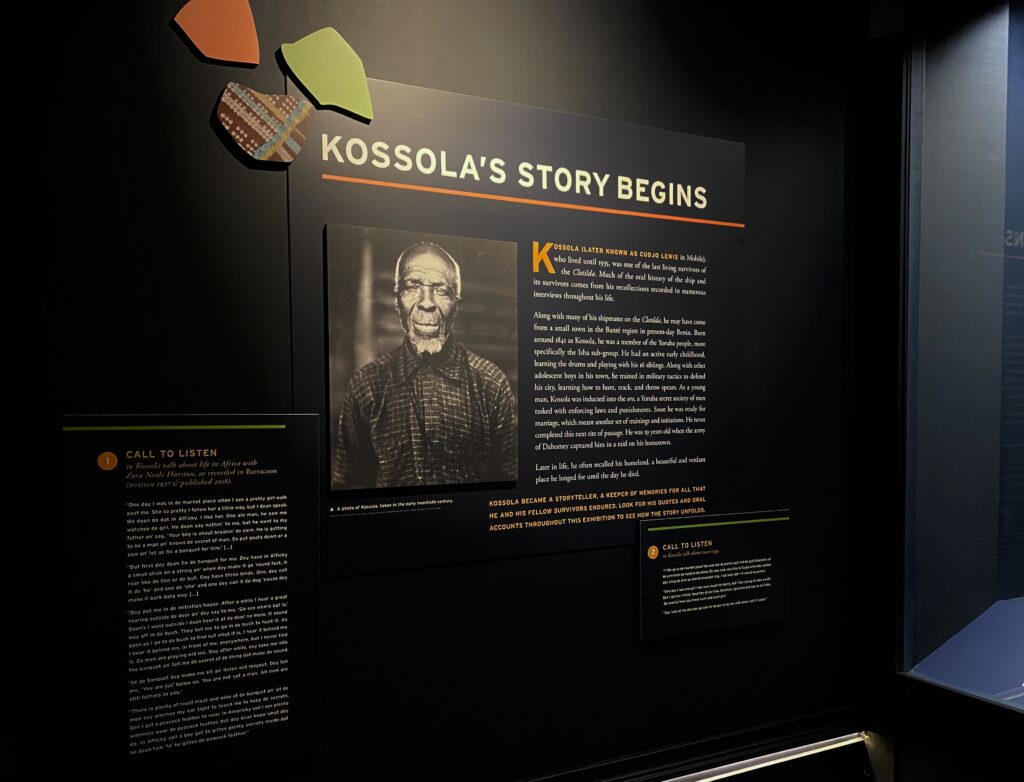
Visitors move through a chronological experience that begins in West Africa, continues through the slave trade and Middle Passage, and follows the survivors into enslavement, emancipation, and the founding of Africatown. Primary-source documents, interpretive panels, oral histories, and artifacts guide the journey.
One of the most powerful elements of the exhibition is the inclusion of recovered pieces from the Clotilda itself. These remnants—recovered from the shipwreck and preserved underwater—offer tangible evidence of the vessel’s identity and history, now on loan from the Alabama Historical Commission.
The exhibition was curated and developed by the History Museum of Mobile in collaboration with Africatown descendants, the broader descendant community, and scholars across the country. Its focus is intentional: to restore individuality to the 110 men, women, and children whose names and stories were nearly lost to history.
A memorial and a living story
(Africatown Heritage House/Contributed)
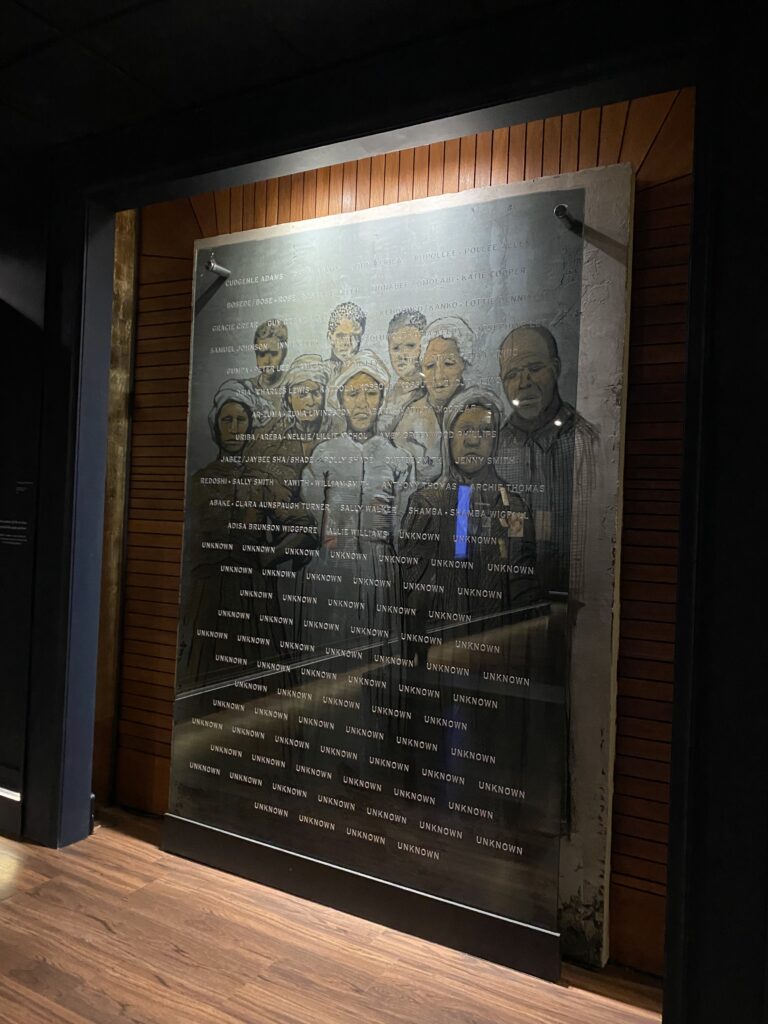
Inside the exhibition, visitors encounter a memorial wall bearing the names of the Clotilda survivors. Some identities are known; others remain marked as “Unknown,” a reminder of the gaps left by historical record-keeping and the enduring work of recovery still underway.
Elsewhere, descendants speak in their own voices through video and audio recordings, reflecting on Africatown’s past, present, and future. The experience extends beyond history into lived memory—how a community carries its origins forward across generations.
The exhibition ends by looking ahead, inviting visitors to consider Africatown not only as a historic site, but as a living community still shaping its own future.
Africatown Heritage House: a place of memory and gathering
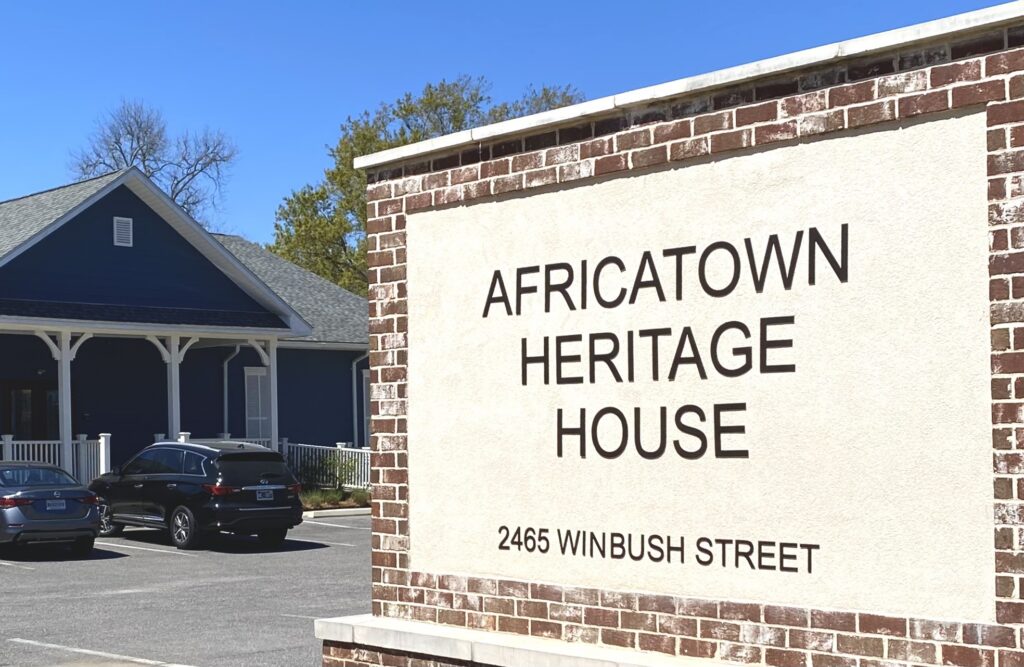
Africatown Heritage House itself stands in the heart of historic Africatown at 2465 Winbush Street. The approximately 5,000-square-foot facility includes exhibit space, offices, and a memorial garden designed for reflection. Its exterior, painted in a shade of blue honoring Mobile County Training School, symbolizes strength, endurance, and continuity.
The site was built through a collaboration led by Mobile County Commission and supported by multiple partners, including the History Museum of Mobile, the Alabama Historical Commission, the City of Mobile, and other local and state organizations. It stands adjacent to Mobile County Training School, itself part of the Rosenwald Schools legacy.
The memorial garden features “The Memory Keeper,” a sculpture created through collaboration between artists Charles Smith and Frank Ledbetter, further grounding the space in art, remembrance, and community expression.
Why the story matters now
The discovery of the Clotilda wreck in 2019 confirmed what Africatown descendants had long preserved through oral history: the story was not lost. It was waiting to be fully seen.
Today, Africatown continues to evolve, with ongoing efforts to expand cultural and community spaces, including Africatown Hall and a planned Welcome Center. These developments aim to ensure that Africatown remains both a historic landmark and a living, self-defining community.
At its center, the story remains the same: 110 people carried across an ocean, stripped of home, who built one in its place—and whose legacy still shapes the world that grew around it.
For more information about Africatown, the Clotilda shipwreck, and the exhibition at Africatown Heritage House—including visitor details, hours, and educational resources—visit their website here.
Never miss a story. Subscribe to our newsletter and get the best of Alabama delivered to your inbox every Friday.