At the northern tip of Mon Louis Island, where Fowl River meets Mobile Bay, the shoreline tells a story about the fragility of coastal Alabama, and the work being done to protect it.
For years, erosion had been steadily eating away at the tip of the island. Over time, weather patterns had reshaped the shoreline, threatening a landscape that served as both a natural buffer for nearby communities and an important habitat for fish and wildlife. By the time restoration planning began, the situation was becoming increasingly urgent.
“It was an eroding shoreline that had become very vulnerable to waves, wind and tropical systems,” said Jason Kudulis, director of the Mobile Bay National Estuary Program. “The infrastructure here was at a point where it was nearing total collapse.”
The solution was not to build a wall and push the water away. Instead, the Mobile Bay National Estuary Program and its partners looked to the natural systems that had protected the shoreline in the first place. The result was a living shoreline—a restoration project designed to work with nature rather than simply hold it back.
Working with nature
(Mobile Bay National Estuary Program/Contributed)
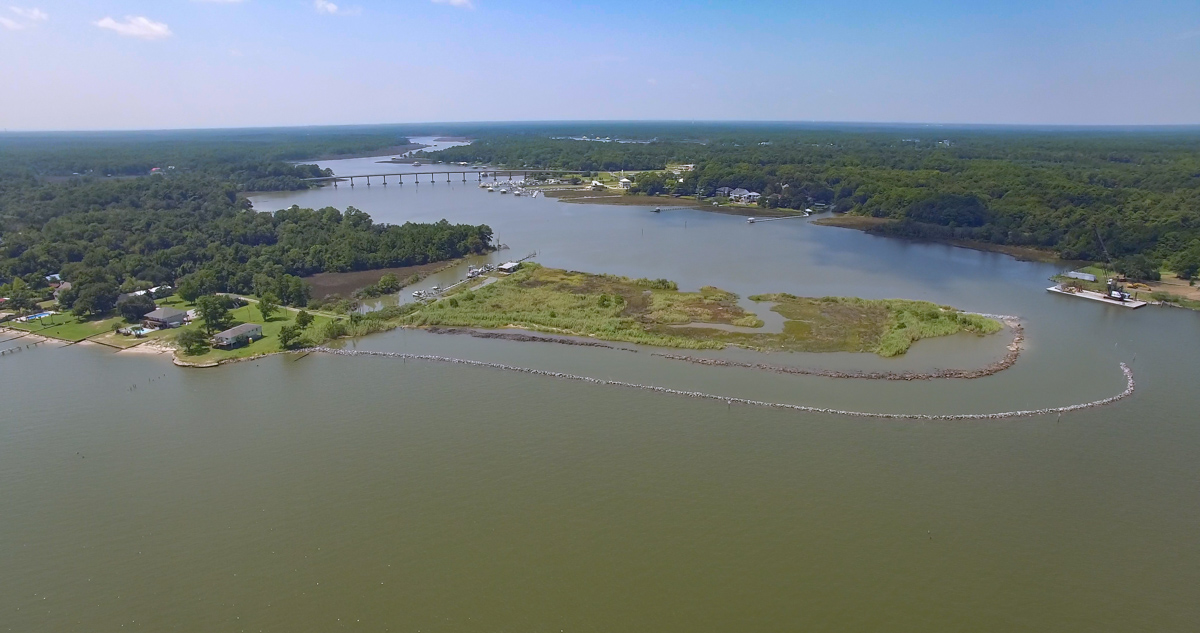
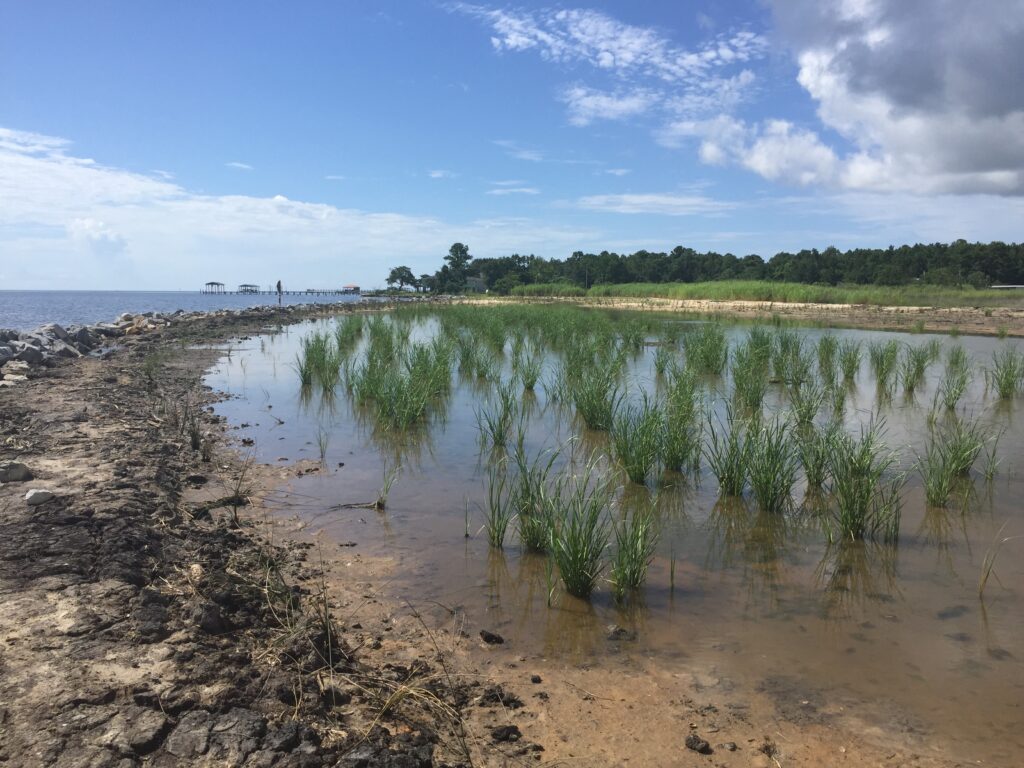
Planning for the Mon Louis Island restoration began in 2013, with construction taking place in 2016. The project restored nearly five acres of tidal marsh at the island’s northern tip and helped return the shoreline to roughly its 1995 footprint.
A continuous rock breakwater was installed along the bay side of the restored area to reduce wave energy. Dredged material was used beneficially to rebuild the land, while a tidal creek network allowed water to move through the marsh with the tides. The design was intentional: use engineered elements where necessary, but recreate as much of the natural system as possible.
“A living shoreline is really us trying to mimic nature,” Kudulis said.
Coastal habitats have their own defenses against storms and erosion. Marsh vegetation slows water, tidal channels allow water to move through the landscape, and wetlands absorb energy before it reaches the communities behind them. “When we come in with heavily engineered components, there can be unintended consequences,” Kudulis said.
That is part of why the National Estuary Program favors what it calls nature-based solutions—approaches that restore or enhance the natural systems already present rather than replacing them entirely. The distinction matters along a coastline where a solution designed to protect one property can sometimes create problems somewhere else.
“A bulkhead may protect one property, but it can bounce that energy somewhere else and change the habitat and the dynamics of the shoreline,” Kudulis said.
And at Mon Louis Island, the goal was broader: protect the shoreline while rebuilding habitat and maintaining the functions of the surrounding ecosystem.
More than one benefit
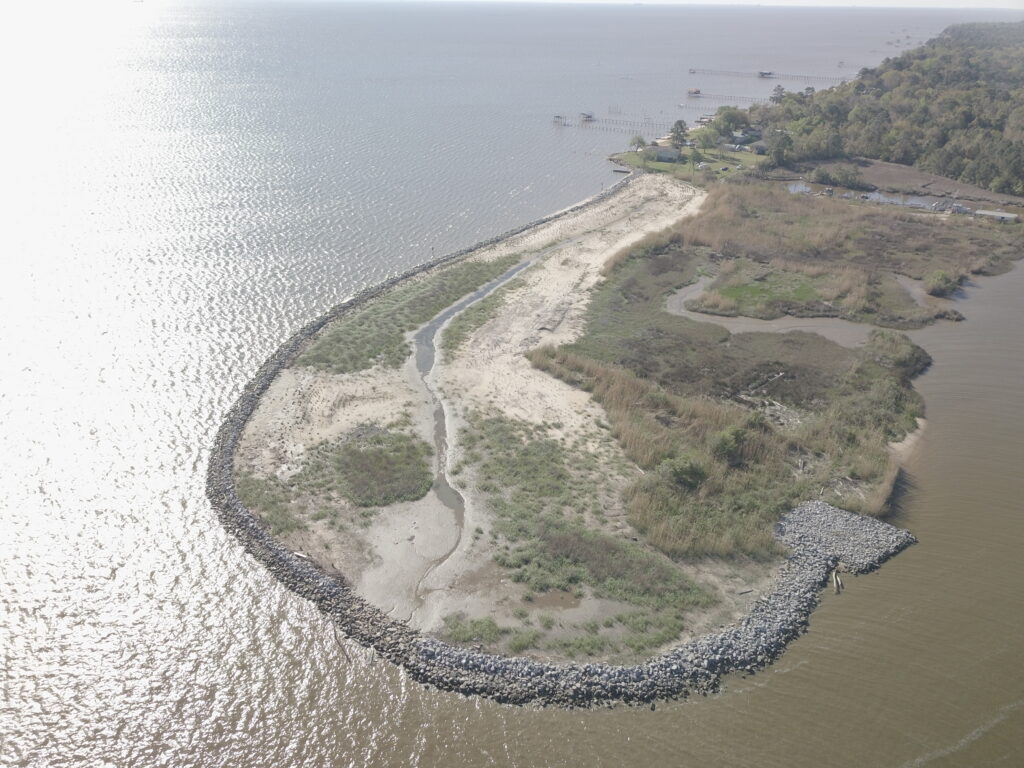
Tip of Mon Louis Island in March 2018 (MBNEP/Contributed)
That philosophy extends beyond a single restoration project. The Mobile Bay National Estuary Program works across Mobile and Baldwin counties, using watershed planning to identify environmental concerns alongside the priorities of the people who live and work in those watersheds.
“We always try to look at projects as multi-benefit projects,” Kudulis said. That means asking questions about water quality and wildlife habitat, but also about access, recreation, commercial activity and cultural heritage.
“We ask people what’s going on, where we need to be paying attention and what matters to them,” Kudulis explained. “That helps us identify priorities early.” At Mon Louis Island, those priorities clearly overlapped.
The restoration helped protect marsh habitat and shoreline while also addressing the shallow Fowl River navigation channel, improving access for recreational and commercial boats. It also provided a beneficial use for dredged material that might otherwise have been treated simply as waste.
“This project is a story of access—access for recreation and commercial boats,” said Henry Perkins, private sector program lead for the Mobile Bay National Estuary Program.
Perkins said the organization’s work often begins with a simple question: How can one project address several needs at once?
The answer at Mon Louis Island was a restoration that could serve people and the environment simultaneously. “Everything is tied together,” Perkins said. “Coastal resources are really the heart and blood of who we are.”
A shoreline worth protecting
(Bama Bay Oyster Farm/Facebook)
For the people who live and work along Mobile Bay, the value of that habitat is tangible. “Fish, shrimp, and crab need these marshes as nursery grounds where they spend the early part of their lives,” Perkins said.
And those marshes are disappearing. “We know our marshes are very threatened,” Perkins said. “We’re losing them, so it’s important to counteract those losses.”
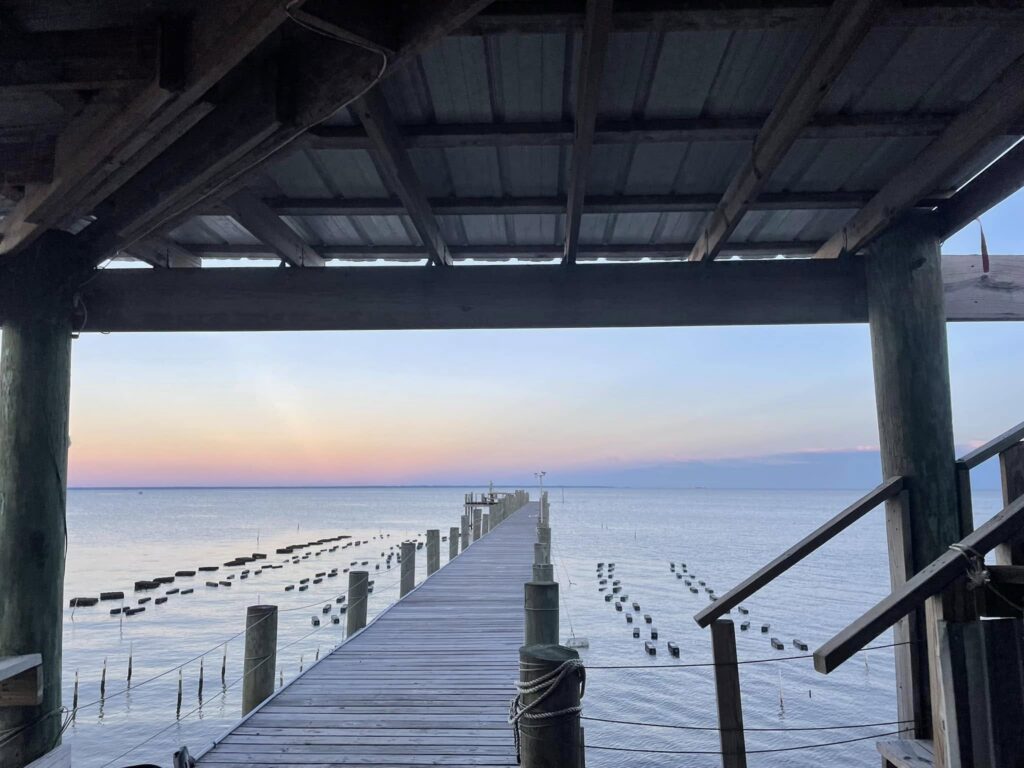
For Jackie Wilson of Bama Bay Oyster Farm, the state’s first woman-owned commercial oyster farm, that loss is something she understands from a lifetime on the water.
Wilson grew up on Mon Louis Island. Her father was a commercial fisherman, and her great-grandmother wove nets. Today, Wilson grows oysters, works in restoration, and collaborates with universities and other researchers.
“I can see my childhood home from here,” Wilson said. “I grew up here all my life, and I’m very grateful to be able to continue doing this in the water I grew up in.”
Her relationship with the bay is both professional and deeply personal. “I’m obsessed with this bay,” Wilson said. “I’m aware of the shifts and changes, what’s normal and what isn’t.”
Wilson also worked with the National Estuary Program earlier in her career, giving her a particular appreciation for the Mon Louis restoration. Bama Bay’s own living shoreline project predates the restoration at the tip of the island. Wilson said Dottie Lawley, who helped establish the farm, was committed to improving the shoreline without building a seawall.
“Dottie was a huge proponent of improving the shoreline,” Wilson said. “She didn’t want to do a seawall; she wanted to do something meaningful.”
Restoration is a relationship
For MBNEP, the physical work of restoration is only part of the equation. The organization also spends years building relationships with the people who live and work in the watersheds it serves.
“This is a unique community,” said Christian Miller, public sector program lead for the Mobile Bay National Estuary Program. “Many families have been here for generations, and we’ve been engaged with them for a long time.”
That history creates something just as important as a successful engineering plan: trust. “We’ve built up trust and a reputation over time,” Miller said. “They know we’re here, and they know we’re going to be here for the long term.”
The goal is for residents to know not only what is happening, but why—and to understand that the people doing the work will remain engaged after construction is complete.
“We want the community to have confidence that when we’re finished, we’re not walking away,” Kudulis said.
That long-term approach also shapes how MBNEP evaluates its restoration work. A coastal project is never truly static. “We believe in adaptive management because you’re dealing with a fluid environment and things are happening all around you,” Kudulis said.
The Mon Louis project has now weathered years of those changes and several storms, providing a real-world test of the living shoreline concept.
“For it to be 10 years old, highly functional and to have held through several storms, that proof of concept has certainly springboarded other projects,” Kudulis said.
Along Alabama’s coast, where marshes continue to disappear and communities remain vulnerable to storms, their work is becoming increasingly important. And at Mon Louis Island, the marsh is once again doing what marshes do best: slowing the water, sheltering wildlife and helping protect the people and places behind it.
Love this story? Subscribe to our newsletter and get the best of Alabama delivered to your inbox every Friday.