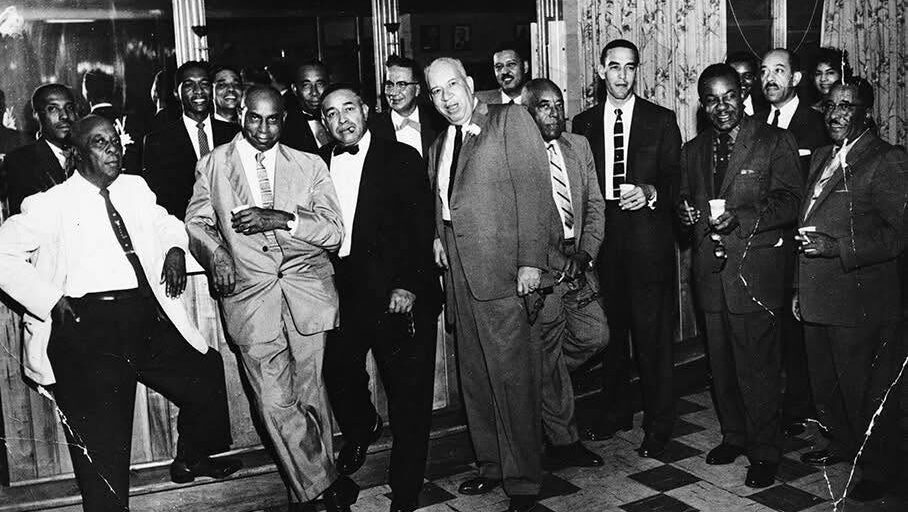
The Utopia Club is showing its age. The brick facade holds strong, weathered by the relentless coastal air, permeating every surface. The doors are still painted for festivities, painted in a diamond pattern of emerald green, gold, and black. I find myself imagining the cars pulling up out front, women stepping out in their best gowns, men in coattails, the whole night ahead of them.
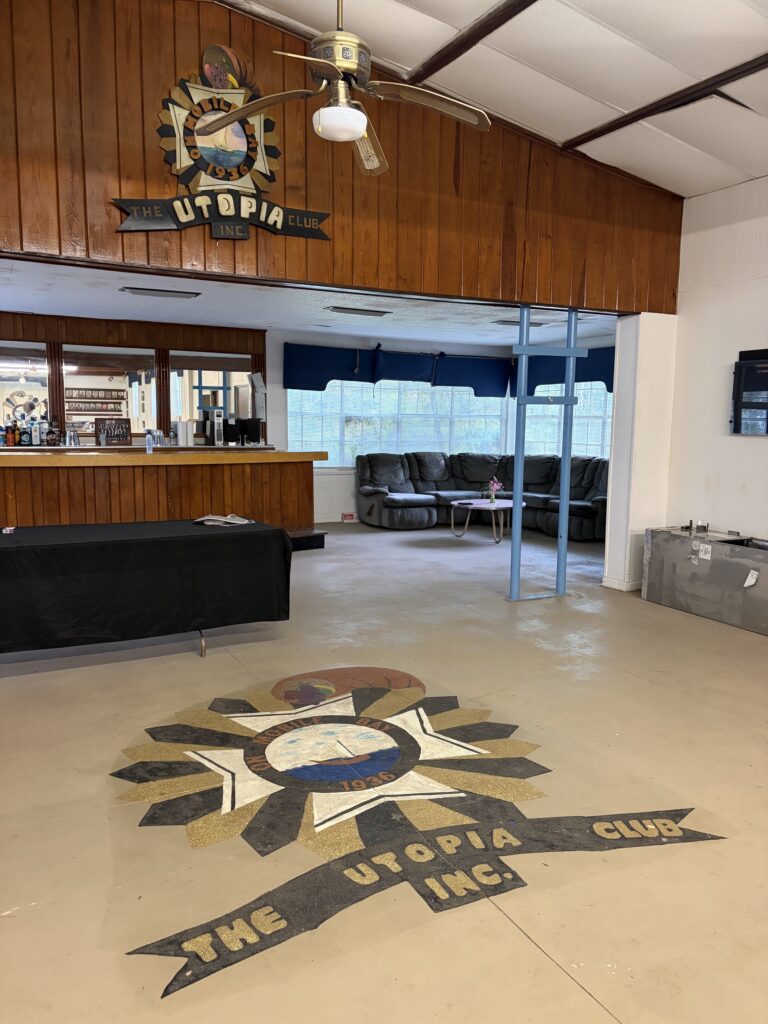
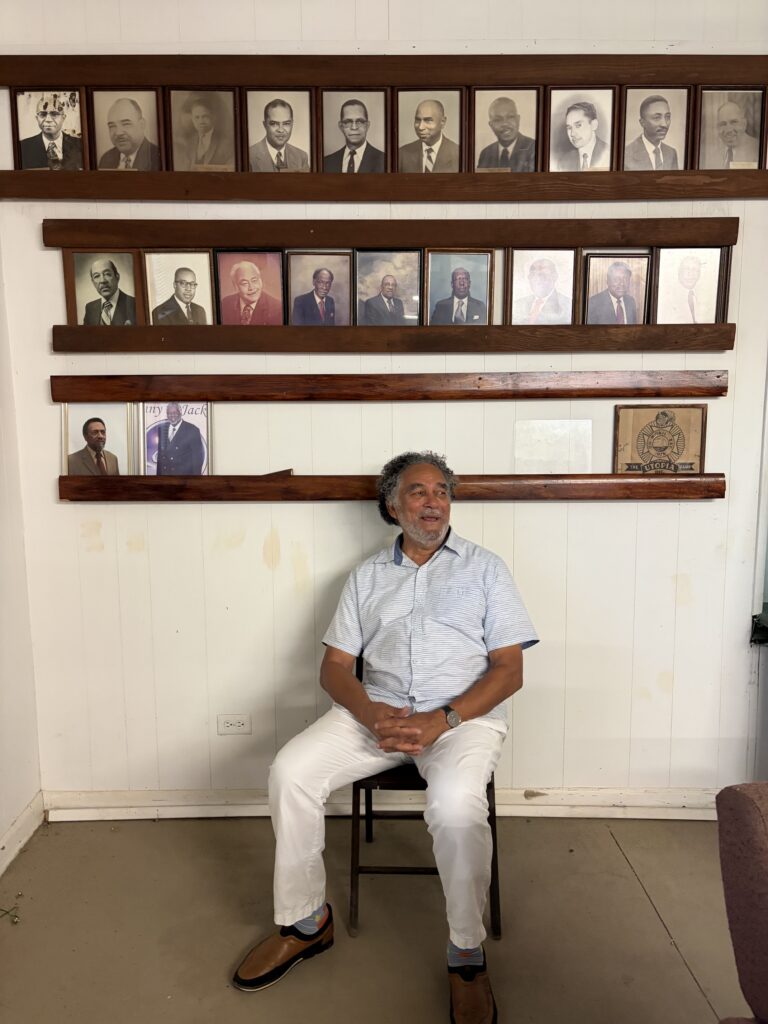
Inside, the first thing I notice is the floor, adorned with a glittery crest and the year 1936. On the far wall hang dozens of portraits, some in color, most in black and white. I’ll learn later that they’re past presidents of the club. Eric Finley is one of them. We sit together at a table beneath that wall.
“Utopia Club: founded in 1936,” he tells me. The country was in the depths of the Great Depression. Mardi Gras was already a big deal in Mobile by then, he says—there was an African-American carnival association hosting balls and parades, and the newly formed Utopia Club became its host. The men behind it were professionals: doctors, teachers, tailors, morticians. Decades of familial pride behind the glass.
“I was born here,” Finley says. “and Jim Crow was king then.”
A Haven on the Water
By the time Finley was born, the world outside these walls had been divided for decades. Alabama’s Jim Crow laws touched everything: where you could sit, where you could eat, where you could swim. The Gulf Coast’s most well-known beaches sat only a few miles from where we’re sitting now, and closed all the same.
“Everything was segregated,” Finley continues. “We couldn’t go to Dauphin Island.”
(Holly Swafford/SoulGrown)
Mon Louis Island became a haven—one of the few places Black families could relax by the water, and a popular site for social clubs like this one.
Finley traces the island’s origins all the way back to French King Louis XIV. “This area back here was originally founded by Creoles,” he says. As he tells it, a French settler named Maximilian received a land grant from the crown, and when Maximilian had a son, his mother called him “my Louis”—in French, Mon Louis. The historical record credits a French colonist named Nicholas Baudin with naming the island sometime after 1710, either for his son or for his own hometown in France. The name has been here since before the United States existed to claim it.
Out of that mix came the Creoles. It’s a word people often mistake for a race, Finley says, but it isn’t one; it’s a cultural identity, built from a specific blend of ancestry and custom unique to the Gulf Coast. I ask him about the Creole origins on the island. “Typically, there was an African American mother, a European father,” he says—French or Spanish blood mixing with African blood, sometimes with Native American heritage folded in as well, over generations of families settling and intermarrying along this stretch of coast. What came out of that mixing wasn’t just people, but a whole way of living: a distinct language, a style of cooking, a set of customs and manners passed down as carefully as any name.
Land of Inheritance
It’s how so many Creole families first came to hold land on Mon Louis Island at all. “They inherited a lot of land in this area,” Finley explains. “When the baby’s dad died, he would leave a will and say, ‘I’m leaving my property to my kids and their mother, and I’m emancipating them.'” It was one of the only paths to freedom and property a Black family could count on.
(Holly Swafford/SoulGrown)
But that inheritance came with a fracture. As Finley tells it, Creole families held rights that Black families who weren’t classified as Creole didn’t—even though the two were often the same bloodline, the same household. “They wouldn’t let them vote,” he says. “They’d let them do everything else, but not vote.” This was still before emancipation.
Some of the family names from that era are still on the island today. Durette. Collins. Driving in, I’d noticed the name Collins on a mailbox—a family lineage that has existed in on the same land for well over a century.
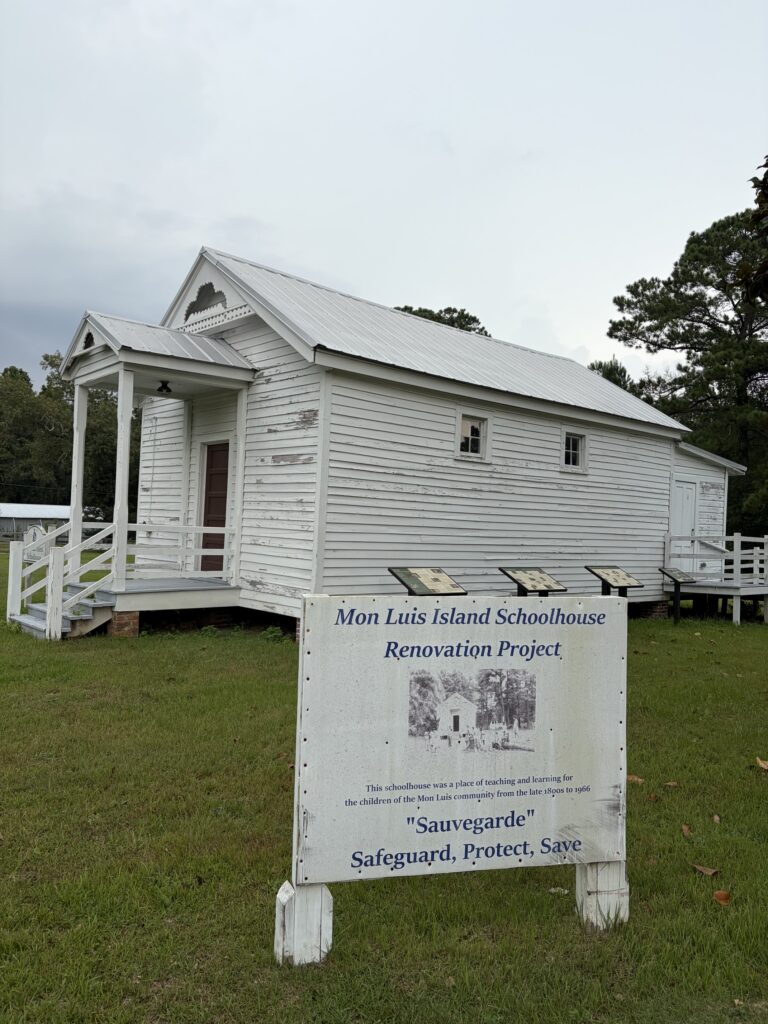
There was a church once, and a school that lasted until around 1966—but it only went up to the fourth grade. Past that, students had to leave the island for Mobile. I drove past that schoolhouse myself after talking with Finley. It’s still standing, a modest 20-by-40-foot building, with a plaque out front. It reads, “this schoolhouse was used to educate the children of the Mon Louis and Bell Fontaine communities from approx. 1890 to 1966.”
Past the fourth grade, Finley says that most residents attended Most Pure Heart of Mary—at the time, the only school in the city that took Black students from first grade through twelfth. A train used to run from the island into the city, and students may have ridden it to get to school. Others took the Greyhound from Daphne—there was no Catholic school on the Eastern Shore either — riding the bus into Mobile, and then walking however far the bus let them off.
“This was a thriving community at one time,” Finley says. “There was a shipbuilding business at Fowl River. Fruit and vegetables went out on the train to the city. And mostly, people here didn’t concern themselves much with what was happening in Mobile. They were happy and content here on the island.”
Tides and Celebrations
I ask Finley to tell me more about his childhood on the island.
(Holly Swafford/SoulGrown)
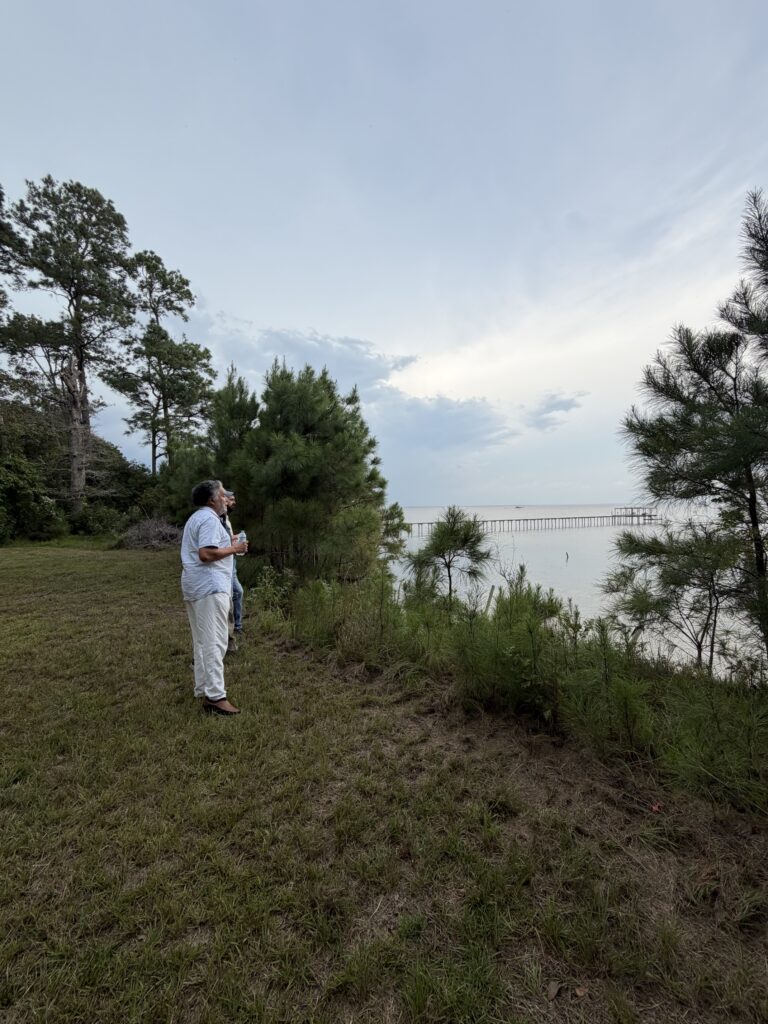
The Fowl River bridge used to be wooden, he tells me, and it wasn’t built for confidence. “Every ten slats, one was missing.” The bus would stop on the far side, and everyone would have to walk across on foot. “No one wanted that bus to come across,” he said laughing.
Once you made it over, though, the water was the whole point of coming. “Everybody that came, came to have fun. And they did.” The Utopia Club held outings all the time, and parents would cook all day for them. “We had a pier out there, a long stairway, you could sit out there. We would take crab baskets and put chicken backs in them, and it would take us half a day to get out there to swim.”
The bay only gave them two windows a day. “Two tides a day only, in and out. Ten in the morning, the tide would be out, so you’d have to go all the way out to really swim.” Kids learned to swim early out of necessity. They’d tie off their crab baskets, wade out into the knee-deep water, and swim as long as they could. “When we got back, those crab baskets would be full of pretty, big blue crabs. You don’t see those anymore. Not like that. Not that big.”
They’d boil the crabs right there on the spot and eat them on the water. “This was my childhood, almost every weekend,” Finley says. “I didn’t know anything about Dauphin Island. We were here, and we were happy. No one bothering anyone. Most people knew everybody.”
Crabs, chicken, barbecue, potato salad are the food memories Finley mentions with a smile. “It was just fun,” he says. “Then certain holidays, things stepped up a bit.” The club was built for the whole family—spring fling for everyone, other nights reserved just for the adults. Finley remembers being a kid inside these same walls. “Blacks couldn’t go to the hotels, auditoriums, until 1964.”
The carnival association Utopia Club helped host in 1936 is still around today, under a different name. “Colored Carnival Association,” Finley says, “is now Mobile Area Mardi Gras Association.” The very first court—the first knights and debutantes ever formally presented to society—came out of Utopia Club. “First coronation of knights from 1940 were from this organization,” he tells me.
Finley leads tours now, and he enjoys setting one fact straight for visitors from New Orleans. “Mobile was founded in 1702. First parade, 1703. New Orleans was founded in 1718.” A pause, then with a smile: “I put the nail in the coffin.” Mardi Gras has become one of the city’s biggest moments of the year, and Mobile has largely kept it to itself. “We are so happy people go over there,” he jokes of New Orleans, “and that way we can have fun.”
“All of This Is Gonna Be Water”
At some point, I ask Finley to speak to both sides of what’s happening here—the culture, celebrations, and life he’s spent the last hour describing, and the environment underneath it, slowly disappearing.
“Environmentally, I don’t have all the understanding of that bay,” he says. “I do know that you have to love mother nature.”
Then he tells me what I already know, what brought me here—that the island is slowly eroding away. “We’ve lost about 30 yards of property over the last six or seven years. And if we don’t address that issue, all of this is gonna be water.” He describes driving out to look at a tree that used to stand on dry land. It’s in the water now.
The blue crabs he grew up catching by the basketful are gone. So are the oysters. He remembers walking the shoreline at dusk with a broomstick fitted with a nail, gigging flounder in the shallows. Several hurricanes have taken out the club’s pier over the years. The last bulkhead collapsed.
“This is the first time we’ve had any entity address what’s happening out there,” Finley says. He’s referring to a restoration project the Mobile Bay National Estuary Program completed at the northern tip of Mon Louis Island in 2016, which armored over 1,500 feet of shoreline with a rock breakwater and rebuilt four acres of tidal marsh using dredged material.
Staying ahead of erosion means staying vigilant, and continued monitoring and support remain critical to protecting what’s been rebuilt. “I’m third generation. I can remember my dad and my granddad trying to get help, but because this is private, it was a challenge.” Three generations of a family, watching the same land erode, without an agency or an entity ever stepping in — because it’s private property, and because, perhaps, of who owned it.
“I think we have to find that happy medium,” he says, “for both the environment and for progress.”
Who We Were
I ask him why all of it—the club, the stories, the tours he gives—matters so much to him.
(Holly Swafford/SoulGrown)
“Life has to be fun sometimes,” he says. “It is so serious. We are so polarized—as cities, as communities, we can’t get along—and it just… I didn’t grow up in a family like that. I grew up in a family where I was human.” He mentions his birth certificate. “There’s a ‘C’ on it. Colored. By the eighth grade, I was ‘Negro.’ By high school, ‘African American.’ But in my family, we always knew who we were. That’s the way we were brought up.”
That, he tells me, is the whole reason for the club’s name. “To come down here and have fun—that’s why it’s called ‘Utopia.’ Nobody owns Utopia.” Every member holds exactly one share of stock, and it can never be sold. “I’m third generation. We’ll keep bringing in the next generation, and continue.”
He offers one last image as a parting thought. “You ever seen a funeral going down the street with a U-Haul connected to it?” he says with a laugh. “It’s a journey, and you gotta enjoy this journey while you’re here.”
Finley turns, finally, to look up at the row of photographs behind us, the same wall I’d noticed the moment I walked in. “I can go through them and tell you every contribution they made to this place, and to the city of Mobile,” he says, “they are pillars of the community in every walk of life.” He and others are putting together a manual now, trying to formally record who each of them was.
He points to one photo. His father, John Finley. Then another, further down the wall. His grandfather, Dr. Franklin—a physician who came to Mobile in 1915. Twenty-two medical clinics carry his name today. “If it hadn’t been for him,” Finley says, “I wouldn’t be here.”
He keeps moving down the row, and the list doesn’t stop. A dentist. A school principal on the Eastern Shore. A postal worker, a tailor, a band director. A doctor who attended the same school as the white doctors in town, and then, because of Jim Crow, couldn’t practice alongside them. “It goes on and on,” Finley says.
Finley is the keeper of their stories. He guards, them, protects them, but most importantly, he speaks them—and will continue to. His voice keeps them alive. He keeps their memory from weathering away.