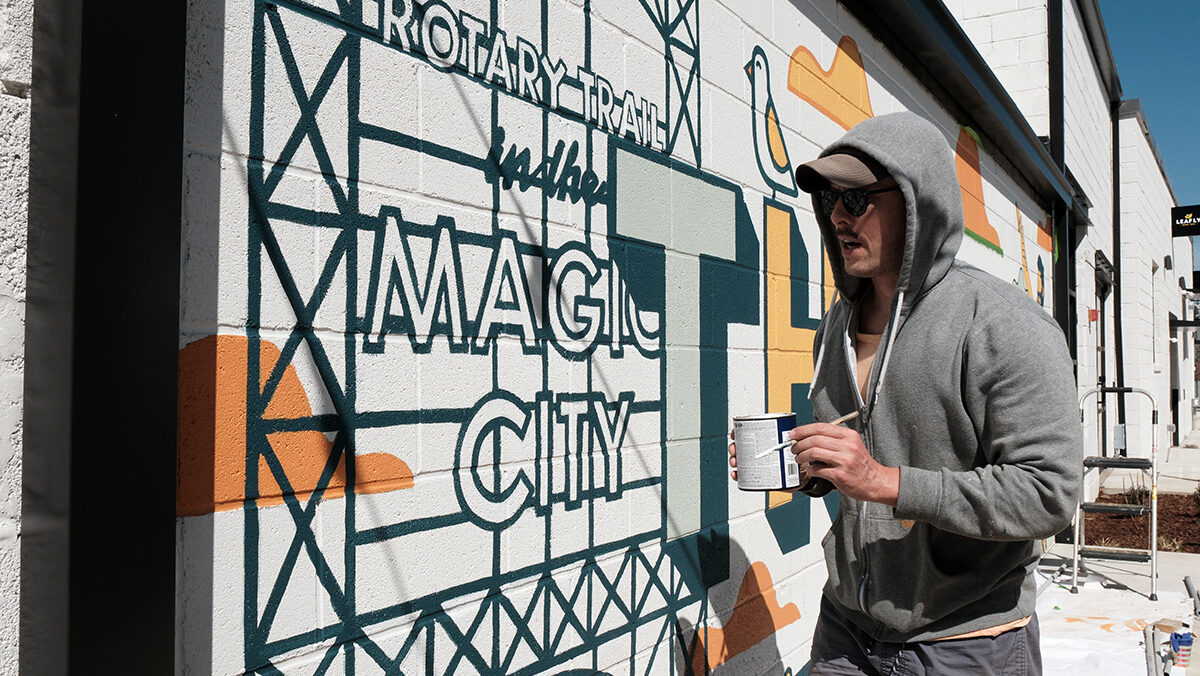
For years, Birmingham artists Rachel “Levi” Levinson and Jordan Thompson have watched mural festivals transform communities in other cities. They have traveled to festivals, painted alongside artists from across the country, learned from one another, and seen what can happen when artists are given the space and the freedom to make work for the sake of making it.
And eventually, they started wondering why Birmingham couldn’t have the same thing.
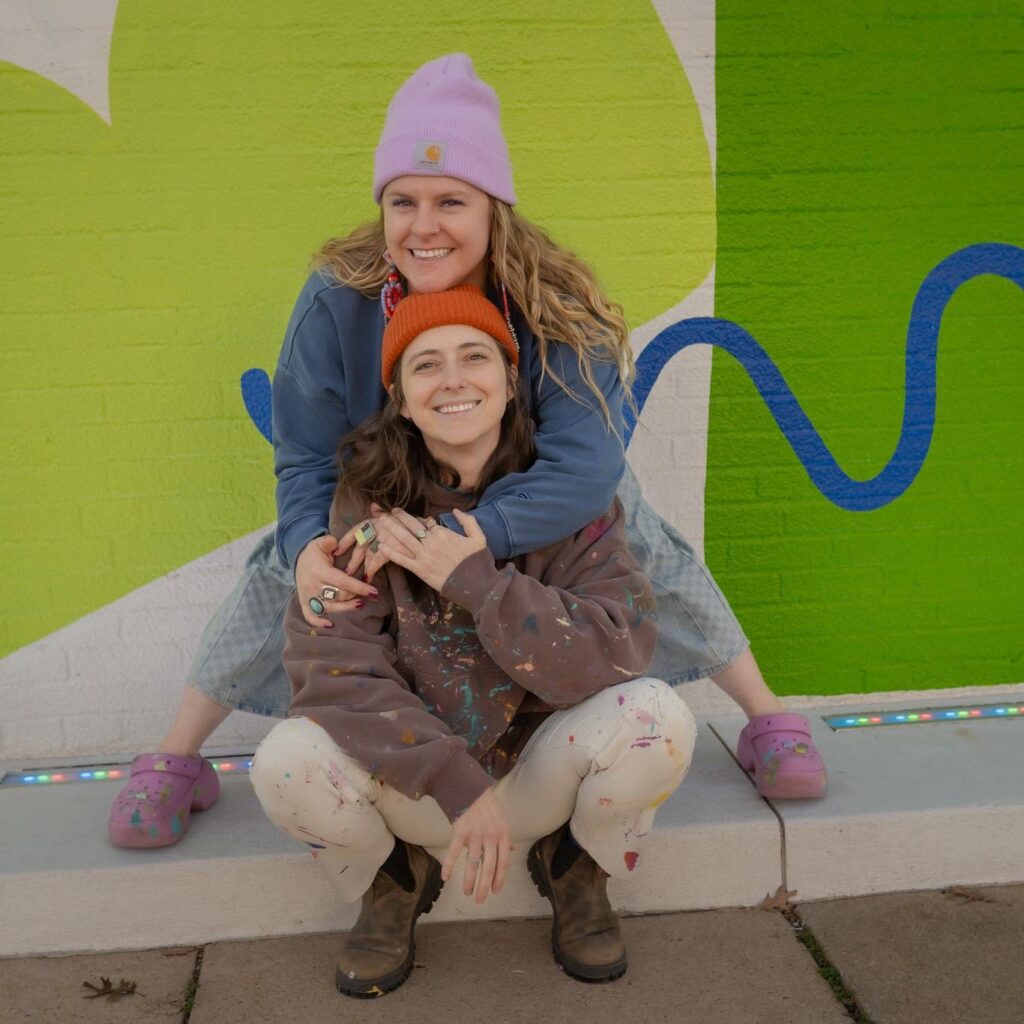
(Bendy Knees Design/Facebook)
That question became Yonder Walls Mural Festival, a first-of-its-kind gathering that will bring more than 40 artists together in Birmingham’s Parkside District later this month. The inaugural festival will fill Urban Supply and its surrounding spaces with new murals, performances, food, educational programming and, organizers hope, a new sense of possibility for the city’s creative community.
But the festival is not simply about adding another collection of murals to Birmingham’s walls. At its core, Yonder Walls is an attempt to create more opportunities for artists—particularly local artists—while showing what public art can contribute to a city.
“We’ve been artists and full-time creators in Birmingham for 10 years, and it has not always been easy,” Levinson says.
Levinson and Thompson, who founded Bendy Knees Design Co., began getting involved with mural festivals outside Alabama several years ago. One of those experiences was the Sunny Dayz Mural Festival in Oklahoma, which travels to rural communities with little existing public art.
“It was like adult summer camp with all of our friends,” Levinson says. “Those are the kinds of experiences that you can’t put a price on. We learned through full immersion: art, exploration and community.”
They also saw firsthand how much a concentrated investment in public art could change a place.
Sunny Dayz, now in its sixth year, became so popular that communities began competing to host it. For Levinson and Thompson, the lesson was clear: public art can change how people see and experience their own communities. “We knew we could make such a great impact,” Levinson says.
Bringing the idea home
Thompson had always intended to bring what she had learned back to Birmingham, and the opportunity came together quicker than she thought.
Sean Gilder, Co-Director & Production Lead of Yonder Walls, had already been thinking about how to bring the mural festival experience back to Birmingham. The connection to Urban Supply eventually opened the door to that possibility, leading the team to developer Hunter Renfroe, who became an early supporter of the project. Renfroe, along with board members including Birmingham Museum of Art school and community manager and artist Lydia Walker and City of Birmingham senior urban designer and artist Erica Chisolm, helped build the network of support behind the festival.
There was also a practical challenge: Convincing building owners to hand over their walls to artists. “It’s hard to sell a mural festival to a building owner because we let the artists paint what they want, within guidelines,” Thompson says.
That freedom for their muralists is intentional. In their work as professional artists, Thompson and Levinson are accustomed to painting for clients, which often means incorporating a business’s branding or marketing into the finished piece. A mural festival offers something different.
“You rarely get to make the artist’s artwork—art for art’s sake,” Thompson says.
Yonder Walls is designed to create more of those opportunities.
Of the 44 artists participating in this year’s festival, Thompson and Levinson say roughly 75 percent are from Alabama. Some professional artists are coming from Florida and elsewhere in the Southeast, but the emphasis remains firmly on artists with connections to the state.
“We wanted it to feel like Alabama artists were having their voices heard,” Levinson says. “We wanted to put it back in the artists’ hands and let people feel proud of saying, ‘Oh wow, an Alabama artist created this.’”
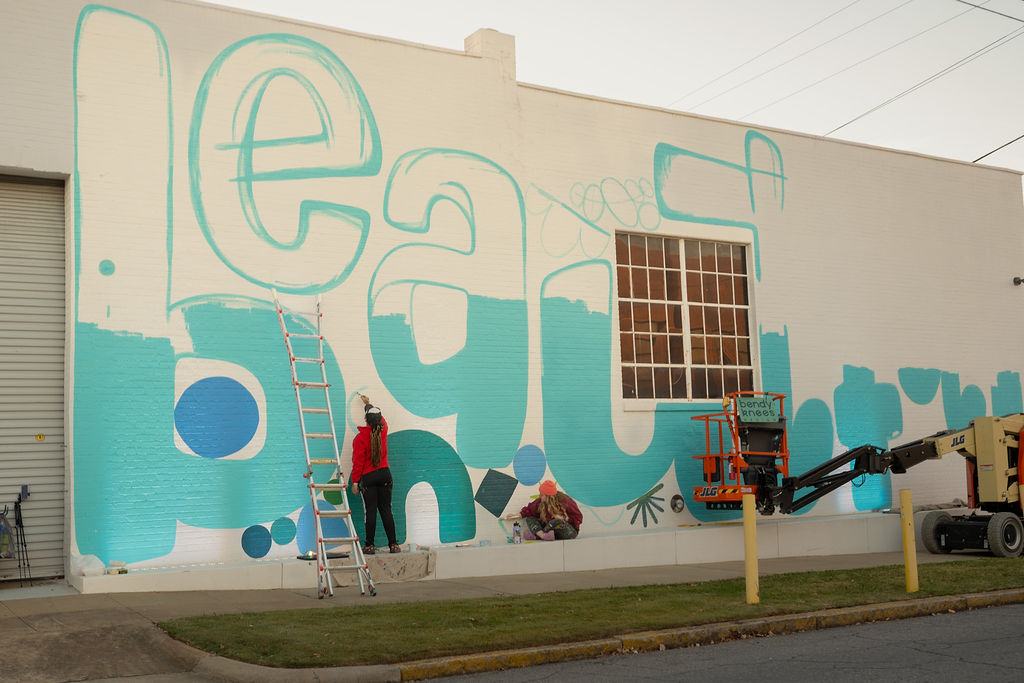
(Yonder Walls/Contributed)
Changing the economics for artists
That philosophy extends to one of the festival’s most ambitious goals: paying artists well.
Yonder Walls is paying artists $12 per square foot, a rate organizers say puts the festival on track to be among the highest-paying mural festivals in the country. Historically, Thompson says, mural festivals have not always compensated artists at that level, if at all. Yonder Walls hopes to change that model as the festival grows.
In addition to paying their artists well, Yonder Walls organizers are intentionally and thoughtfully building year-round opportunities for education and mentorship. The goal is not only to bring established muralists to Birmingham, but to make the festival a point of entry for artists who have never painted a mural before. This year, about 35 percent of the participating artists are first-time muralists.
“We want this to be for everyone,” Levinson says. “There’s no age limit.” And it truly is–the festival is hosting artists of all backgrounds and ages. One of those first-time muralists is a 72-year-old retired Miles College professor.
For younger artists, that same exposure can be just as significant.
Yonder Walls received 22 applications for its inaugural mentorship program and selected 14 students between the ages of 16 and 19. All students will work alongside seasoned muralists, learning everything from rendering to the practical realities of working as a professional artist.
The mentorship is deliberately collaborative rather than strictly one-on-one. Students will watch artists work, travel together, ask questions and see different approaches to mural-making.
The organizers are also working with schools and community partners to create educational programming throughout the year, including creative meetups, workshops and panel discussions.
Public art, in public
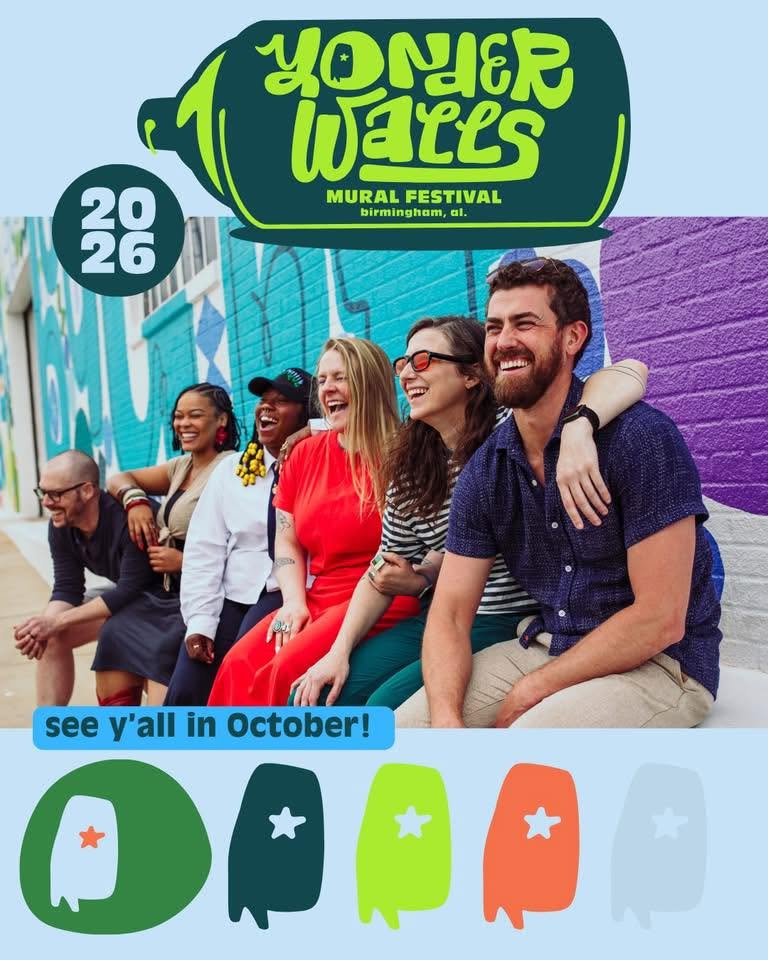
(Yonder Walls/Facebook)
The murals themselves will begin appearing before the festival. Artists are scheduled to begin painting on October 10 and will work throughout the week, weather permitting. That gives Birmingham residents a chance to see the process rather than simply arriving to find finished walls waiting for them.
The festival culminates Saturday, October 17, when Urban Supply will host a free day of performances, local food trucks, vendors and activities from noon to 8 p.m.
The Birmingham Museum of Art is partnering on a kids’ zone, where children can paint cardboard houses and create their own miniature walls. Organizers are also working with area conservancies to highlight endangered species native to Alabama, connecting the artwork to the natural environment beyond the city.
“We want the public to feel ownership of it,” Thompson says. “This is for your city, by your city.”
That sense of ownership is part of what drew the organizers to Birmingham in the first place. Levinson says the city’s art community is strong and interconnected, even if artists can sometimes work in separate circles.
“I stayed here because the art community here is so strong,” she says. “We’re all interconnected, but we’re also siloed. We’re trying to teach the up-and-coming artists that we can all do this. We don’t have to compete.”
That may be one of the more lasting ambitions of Yonder Walls: not simply to create more murals, but to strengthen the network of people creating them. “You can be a successful creative, but you have to do it as a team,” Levinson says.
A new layer of Birmingham’s identity
Birmingham already has strong visual storytelling. Its industrial history, Civil Rights landmarks, neighborhoods and architecture have given the city plenty of stories to tell. Its creative economy has grown alongside its reputation for food, music, medicine and technology. Yonder Walls organizers see public art as another piece of that identity.
“Street artists are really starting to turn heads and think about what public art can do for their community,” Thompson says. Public art can change a wall, but it can also change the way people move through a neighborhood. A blank surface becomes a landmark. A local artist’s work becomes part of the visual record of the city.
And, Thompson hopes, a business owner looking for an artist in the future might have somewhere new to look.
That’s the larger mindset behind Yonder Walls. The festival will last a week, but the organizers are thinking beyond October—toward a Birmingham where artists have more opportunities to work, more reasons to collaborate, and more places to leave their mark.
This October 17th, grab a chair or a picnic blanket, and watch as the walls come to life.