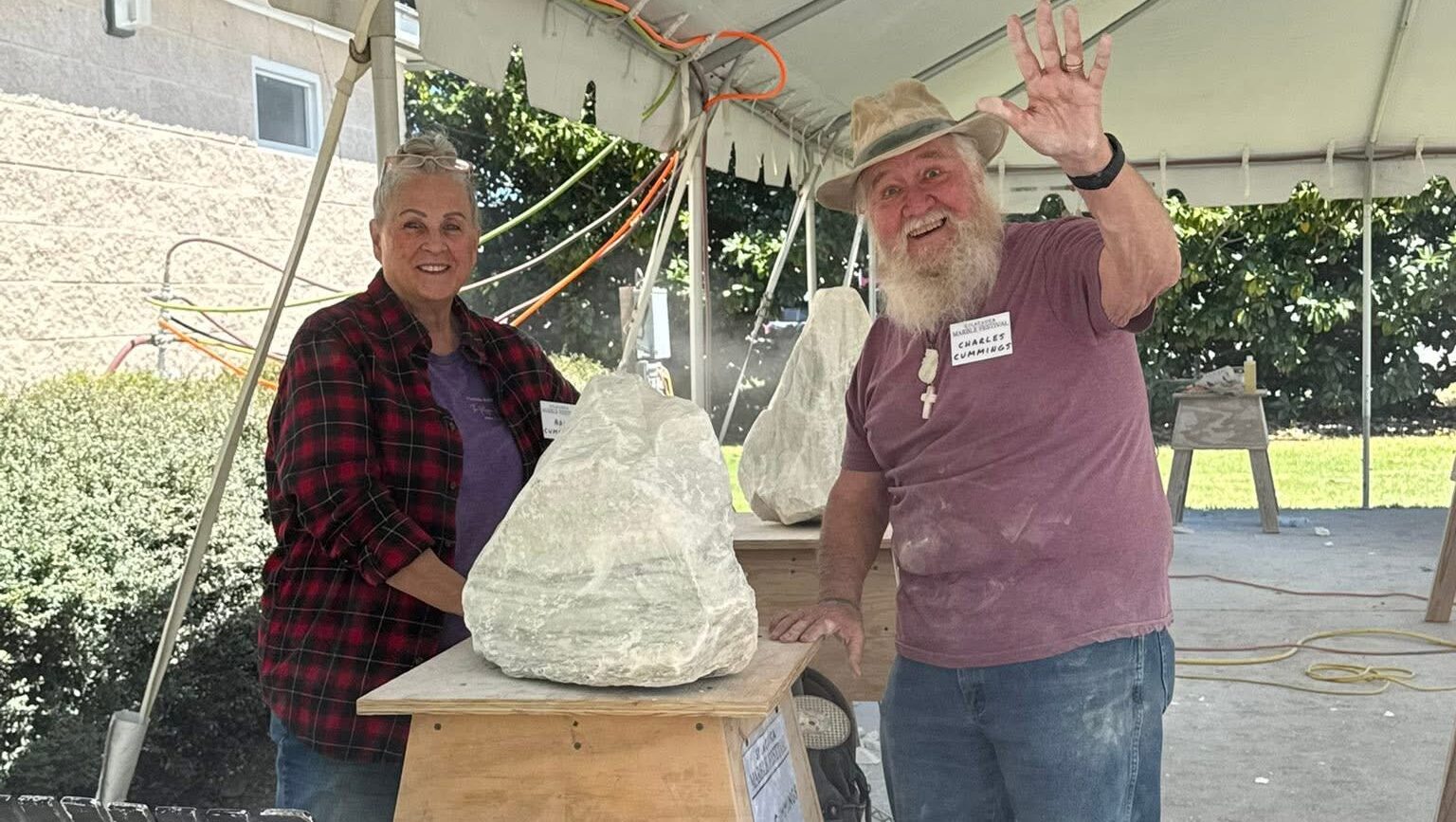
“We kind of like each other,” Charles Cummings laughed, teasing the woman who has spent more than four decades by his side. “Just a little bit,” his wife Ada added.
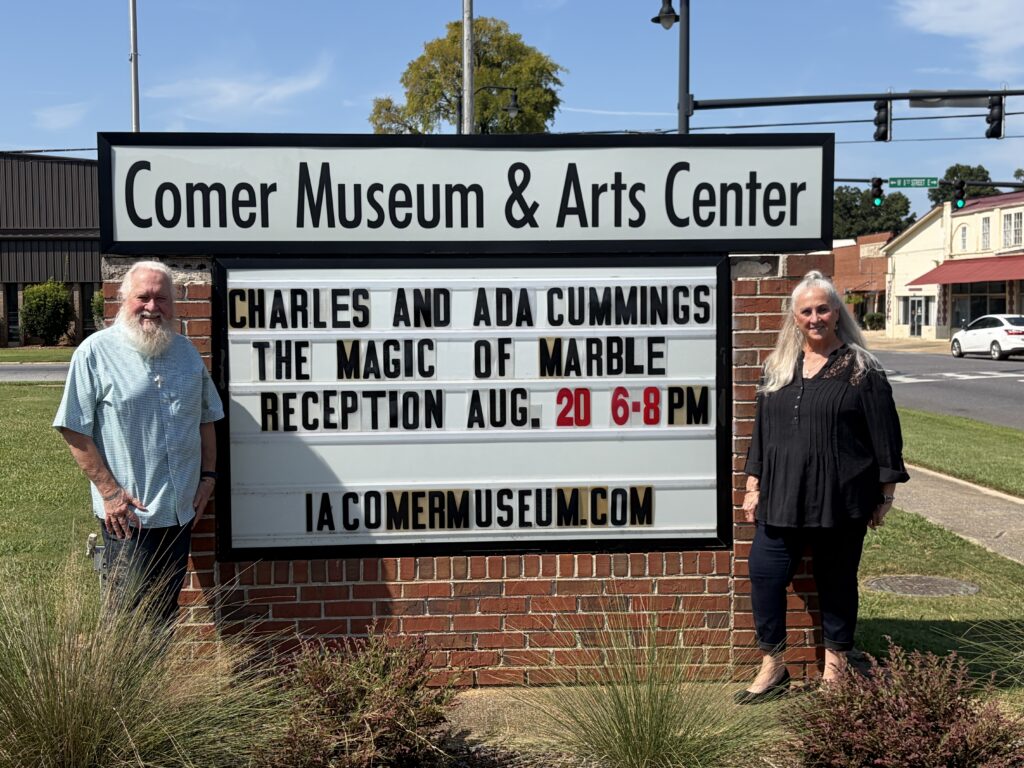
The exchange is playful, but it reveals the rock-solid foundation of the life they have built together. Charles and Ada Cummings are best friends, creative partners, and self-taught sculptors who turn pieces of Sylacauga marble into crosses, human figures, and other works of art.
Married for 44 years, the Cummingses live in Titus, where they sculpt professionally at their home nearly every day. Before retirement, Charles owned a business where Ada also worked, so creating side by side is simply the latest chapter in a lifetime of working together.
I met the couple at Sylacauga’s Magic of Marble Festival, where I was immediately drawn to their work. But in a separate program at the festival, I listened to them lecture passionately about sculpting. Their connection captured my attention even more. In addition to being two artists working side by side, they share a deep affection for the craft.
They joked about liking each other, but their devotion to Sylacauga marble is no laughing matter. They prefer the local stone for its workability, natural color variations, and connection to the local sculpting community they now consider family. I felt that sense of family as I walked among the sculptors at the festival. They shared tools, exchanged advice, and welcomed visitors into their creative process.
Sylacauga’s identity has long been shaped by the stone beneath it. Known as the Marble City, the town sits atop a marble bed approximately 32 miles long, 1.5 miles wide, and 400 feet deep. Although the area is best known for its acclaimed white marble, the stone can also contain shades of pink, gray, and other natural variations. Charles and Ada let these details help shape their work. Their contrasting approaches to the stone have become one of the strengths of their creative partnership.
From a pocketknife to marble
(Charles and Ada Cummings/Contributed)
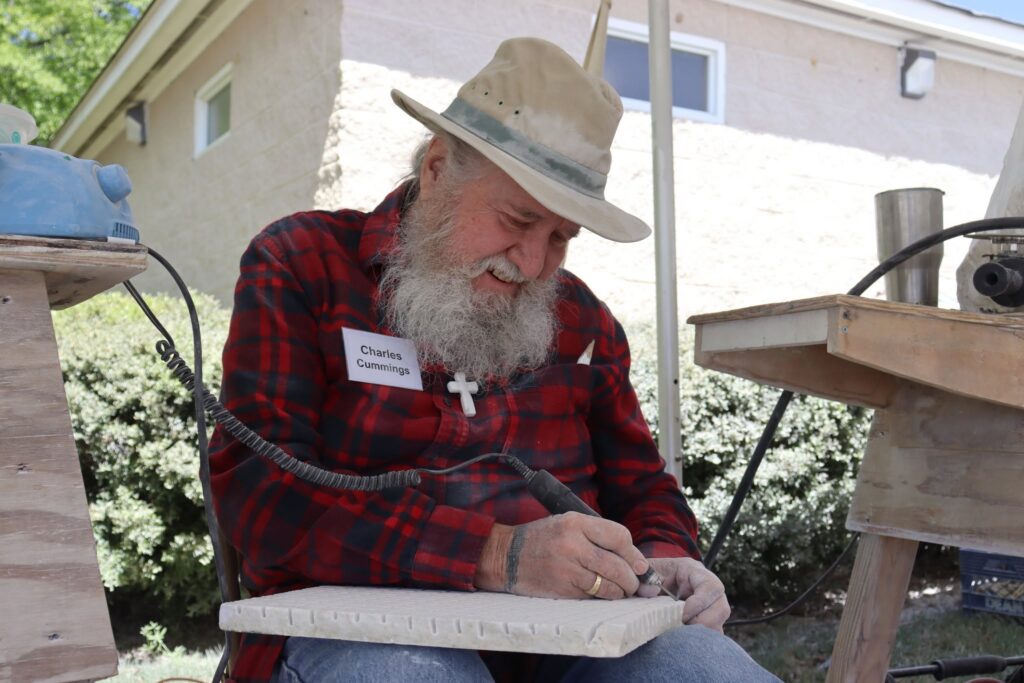
Charles began carving long before he encountered the marble that would eventually become central to his artistic life. “I started carving when I was about 5 years old with a pocketknife and a piece of wood,” he says.
Over the years, he progressed from those childhood pieces to more serious woodcarving and then to carving deer antlers. Nearly nine years ago, he accepted an invitation to participate in Sylacauga’s Magic of Marble Festival—even though he had never carved marble.
“I thought, ‘Well, why not?’” he recalls.
The experienced sculptors welcomed him, offering advice and sharing tools and strategies. Many of the tools Charles had used for wood could also be used on stone, though he quickly discovered that marble required considerably more time and patience.
“The stone carves very much like wood, but it’s about four times slower,” he says.
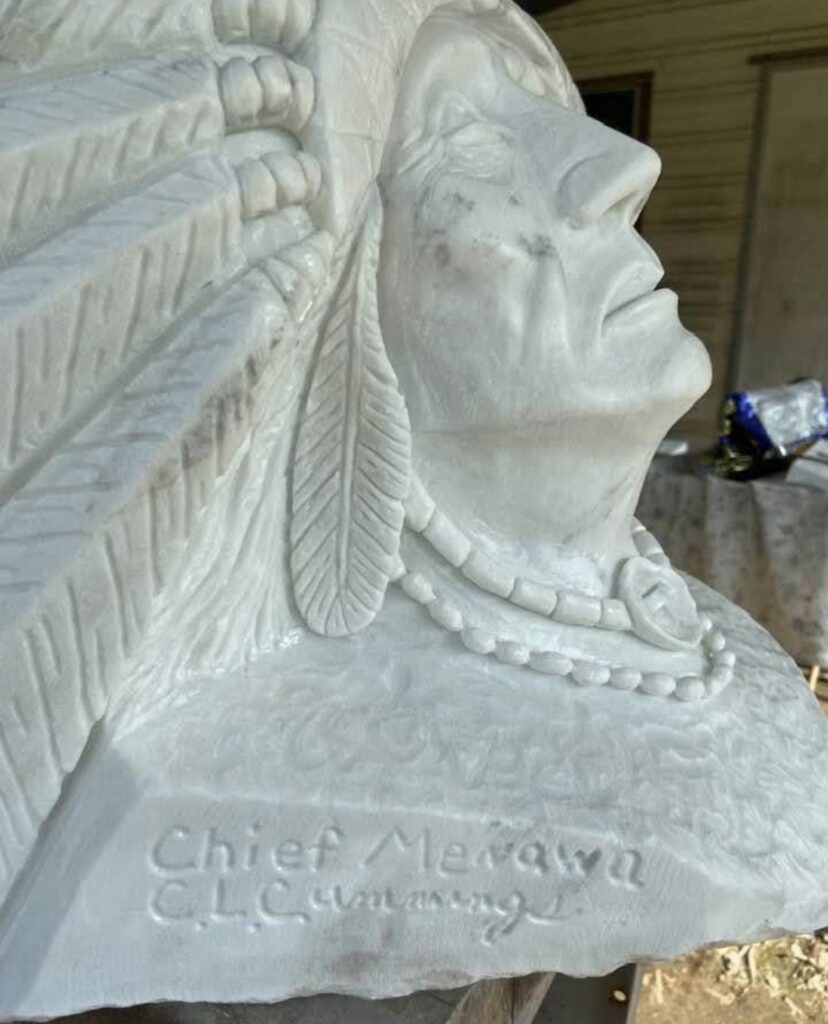
A fellow sculptor gave him a used blade for his angle grinder and showed him how to use it. By the end of the festival, Charles had created a large Native American figure with a full headdress.
“That was the first time I’d touched it,” he says.
From watching to carving
(Charles and Ada Cummings/Contributed)
Ada did not begin carving immediately. At first, she was content to simply watch Charles sculpt.
She and her mother would sit on the back porch and watch as he carved faces from pieces of wood. Ada paid close attention to the process, even though she had not yet picked up the tools herself.
“It was fascinating to watch him pull faces out of a piece of wood,” she says.
Then came the unfinished Santa Claus—or at least, a Santa Claus Ada believed was unfinished. Charles had stopped working on the wooden figure, but Ada could still see details she thought it needed. She picked it up and completed the face herself.
“After that, I thought, ‘I can do this,’” she says.
When Charles attended his first Marble Festival, she attended as a quiet observer, there to support her husband.
“I said, ‘I’ll watch. I’m not doing it,’” she recalls.
That resolve didn’t last long. Once they returned home and Charles continued working with marble, Ada began experimenting with it, too. By the next festival, she had her own table and her own work to display.
Two ways of seeing the stone
For Charles, selecting marble begins with seeing beyond its rough surface. “When I look at a rock, I see what’s in it,” he says. “All I have to do is remove all the extra, and it’ll be there.”
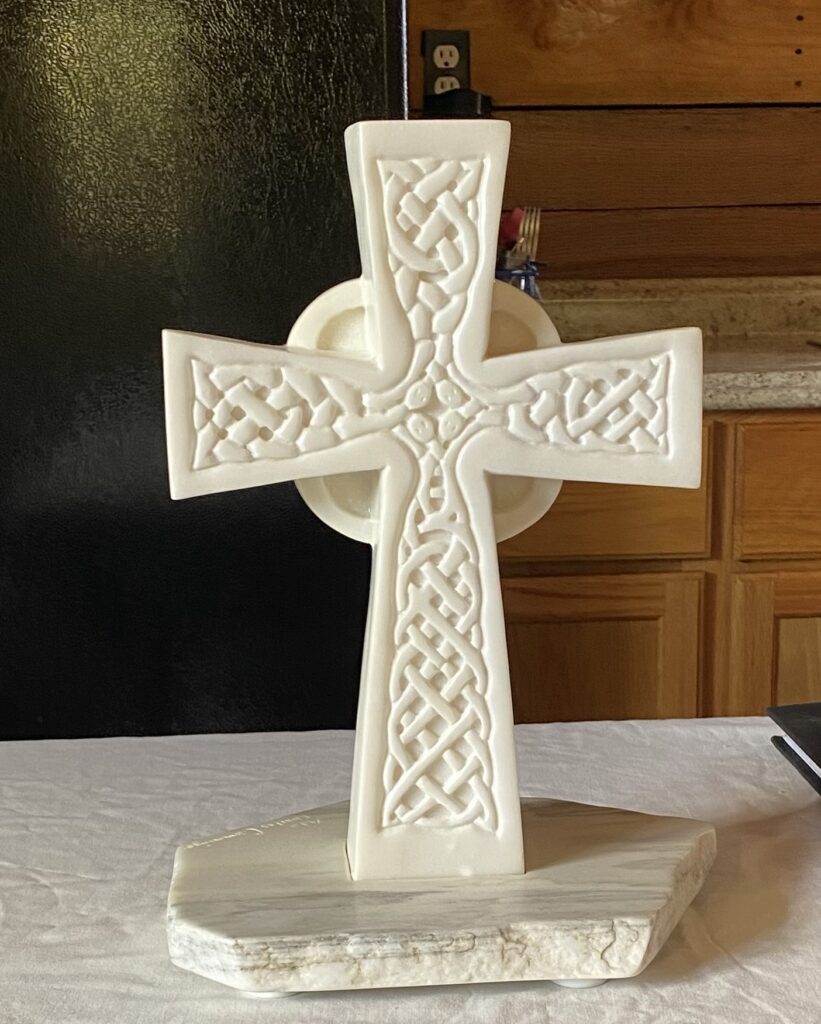
Ada’s process is less predetermined. She may know the general form she wants to create, but the details reveal themselves gradually. That is especially true of the crosses for which she has become known.
“I know it’s going to be a cross. I just don’t know what kind yet,” she says. “The closer I get to being finished, it’ll hit me what I want to do.”
She might add something to the center, change the edges, or leave part of the marble untouched so viewers can see the transformation from raw material to finished art. Some crosses feature Alabama Rose, a variety of local marble with streaks of pink and gray. Others retain crystals, gold tones or other variations the couple discovers within the stone.
Ada’s says her connection to the crosses is also spiritual.
“They speak to me, every one of them,” she says. “It warms my heart to know that I can do it and God has allowed me to do this.”
Thought Ada is best known for crafting crosses. She’s also tried her hand at figurative pieces, too. One of her figurative pieces, titled Sunshine, depicts a woman with closed eyes and her face lifted upward.
“To me, that was like me standing out on the back porch, praying to God,” Ada says.
Patience, persistence, and partnership
(Charles and Ada Cummings/Contributed)
The Cummingses credit their success as a carving duo to patience, persistence, and partnership. Charles especially admires Ada’s patience.
“She will sit and work on a nose for two days,” he says. “She is so determined and so dedicated to making it look just right.”
Ada admires Charles’ persistence. “If he decides that’s what he’s going to do, he does it,” she says. “He never gives up.”
Patience and persistence are necessary when working with marble. A hidden crack or “bruise” can cause part of the stone to break away beneath the vibration of a tool. When the nose fell from one of Charles’ figures, he carved deeper into the marble and began again.
“The third nose worked,” he says with a laugh.
Long before the Cummingses became artistic partners, they built a life around shared experiences, including hunting, fishing, working and traveling. “We do everything together,” they say, almost in unison.
Their carving slows down around the Christmas holidays, when another shared role takes priority. The Cummingses trade their sculpting tools for their second-favorite pursuit together: spreading holiday cheer as Santa and Mrs. Claus. You might say their seasonal work takes them from the Marble City to the North Pole.
Charles believes friendship is the key to their partnership. “The most important thing I’ve found out about marriage is you have to like your partner,” he says. “Love and all that is good, but on top of that, you have to like them.”
Finding family at the Marble Festival
(Charles and Ada Cummings/Contributed)
Charles and Ada have also found an extended family among the sculptors who return to Sylacauga each year.
“There’s no competition at all,” Charles says. “I’ll help anybody, and anybody there would help me if I had a question.”
Artists share tools, offer suggestions, and welcome newcomers beneath the festival tents. Charles and Ada have become known for talking with visitors and giving them opportunities to experience the stone for themselves.
If Charles is preparing to remove a small piece of marble, he may hand a visitor the hammer and chisel and show them where to strike. They often keep the chip they remove as a souvenir.
“That’s a trophy for them,” he says.
The couple has also helped new sculptors continue learning beyond the festival. Some have visited their home in Titus to carve alongside them. Charles and Ada occasionally offer informal lessons, but they do not charge.
“We like to have fun,” Charles says. “We don’t want pressure. We want to enjoy it. We want whoever comes to see us to enjoy it as well.”
That same desire influences the commissions they accept. They are open to ideas, but neither enjoys being given rigid instructions about exactly what a finished sculpture must look like.
“If somebody gives us an idea—something they’re interested in—and then lets us do our part, we’re okay,” Ada says. “It has to be fun.”
Still shaping a life together
There are still pieces the couple hopes to create.
Charles wants to carve a face covered by a veil, inspired by the remarkable marble veils seen in centuries-old sculptures. Ada wants to create another female figure, one so lifelike that she appears ready to speak.
They are also working on a sculpture that may best represent their creative partnership. Ada will carve a woman on one side of a large stone, while Charles will carve a man on the other. The figures will sit back-to-back, each shaped by a different artist but joined within the same piece of marble.
It is a fitting image for the life Charles and Ada have carved together: two distinct people with different instincts, methods, and artistic voices, connected by friendship, devotion, and a shared belief that even the roughest stone holds the possibility of something beautiful.
Love this story? Subscribe to our newsletter and get the best of Alabama delivered to your inbox every Friday.