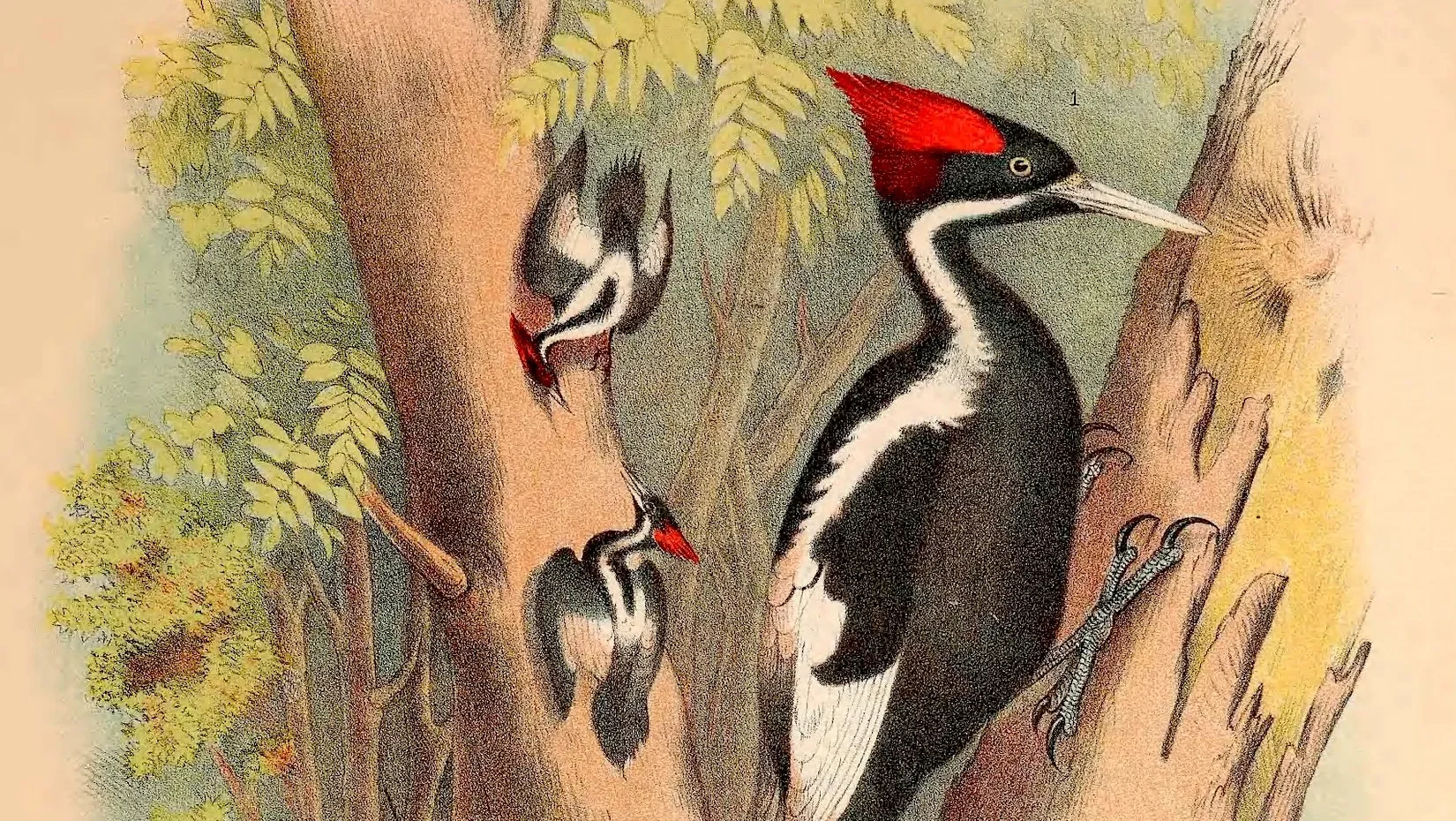
Few birds have inspired as much fascination—or as much debate—as the Ivory-billed Woodpecker. Once found throughout Alabama’s bottomland forests, the bird has long been considered extinct. Yet decades after its last universally accepted sighting, people across the Southeast still insist they’ve seen it.
The Ivory-billed Woodpecker, also known as the “Lord God Bird,” earned its nickname because early observers reportedly exclaimed, “Lord God!” when they first caught sight of one. Many scientists believe the species is gone forever—but some birdwatchers, hunters, and researchers remain unconvinced. The last universally confirmed sighting occurred in 1944.
The U.S. Fish and Wildlife Service listed the species as endangered in 1967, and today it is generally considered extinct. Yet sightings continue across Alabama and the Southeast. Could Alabama still be hiding one of North America’s most famous missing birds?
Meet the Lord God Bird
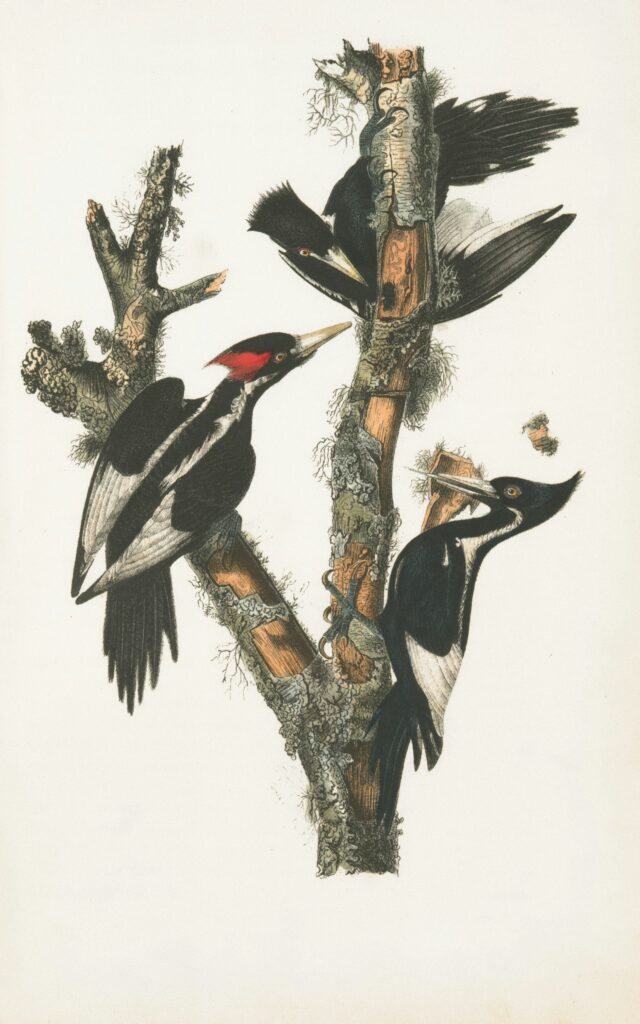
(The New York Library Digital Collections/Public Domain)
The Lord God Bird was one of the largest woodpeckers in North America. It was recognizable for its distinctive ivory-colored bill, striking black-and-white plumage, and the vivid crimson crest found on male birds.
Its size and striking appearance, paired with its elusiveness, made it a favorite among birdwatchers and outdoor enthusiasts alike. It preferred large old-growth bottomland forests along rivers and floodplains, and even before its alleged extinction, spotting one was considered a rare treat.
While sightings of this ancient, intelligent bird were uncommon, it once ranged throughout much of the southeastern United States, especially Alabama. The centuries-old hardwood forests lining the Tombigbee, Alabama, and Tennessee rivers, along with the Mobile-Tensaw Delta, provided ideal habitat for the species.
Unlike many other woodpeckers that forage on smaller branches, the Ivory-billed Woodpecker specialized in stripping bark from recently dead or dying trees to feed on wood-boring beetle larvae beneath the bark. Alabama’s abundance of aging hardwood forests once provided exactly the conditions the species needed to thrive.
The bird was thought to be wary of humans, making the vast, largely untouched forests of the 1800s an ideal home. When the logging boom of the late nineteenth century began, however, many of those ancient hardwoods were among the first trees harvested because of their tremendous value.
The Bird That Disappeared
For a bird with such specialized habitat and dietary needs, the loss of those forests proved devastating. As the species became even rarer, collectors and hunters also began targeting the birds. Museums sought specimens, private collectors prized them, and some were hunted simply because they were large and unusual.
While hunting alone did not doom the species, it placed additional pressure on an already declining population. Small populations face a host of challenges, from finding mates to maintaining enough genetic diversity to withstand disease and environmental change. As those pressures mounted, the Ivory-billed Woodpecker became increasingly vulnerable.
By the mid-1900s, the bird had all but disappeared. But disappearance does not always mean extinction.
Modern Sightings and the Mystery
The last definitive and widely accepted sighting of the species occurred in April 1944 at Louisiana’s Singer Tract. Even so, unconfirmed sightings continue to this day.
Throughout Alabama and the Southeast, casual outdoor enthusiasts, experienced biologists, and ornithologists alike have reported fleeting glimpses of what they believe to be the bird. Researchers have also recorded distinctive “double-knocks” and nasal “kent” calls that closely resemble historical recordings of the species.
Experts have documented large patches of bark stripped from trees—feeding behavior that some believe could only have been made by a bird of the Ivory-billed Woodpecker’s size and strength. Those who believe the species still survives argue that the remaining bottomland forests are expansive enough to conceal a very small population.
In biology, proving that a species is completely extinct is extraordinarily difficult. There is also historical precedent for so-called “lost” species returning. Birds such as the Cahow in Bermuda and Australia’s Night Parrot were once believed extinct before being rediscovered decades later.
These discoveries have inspired several multi-year scientific searches over the past two decades. In 2005, researchers—including teams associated with Auburn University—conducted an extensive search along Florida’s Choctawhatchee River. They documented 14 eyewitness sightings, captured multiple double-knock recordings, and identified several feeding sites consistent with the bird’s historic behavior.
A 2023 peer-reviewed study even argued that drone footage may have captured the bird in flight, though many ornithologists remain skeptical of the evidence. Whether convincing or not, reports like these continue to fuel one of North America’s greatest wildlife mysteries. If a living population were ever confirmed, it would reshape modern conservation—and prove that one of the continent’s most famous “ghost birds” never disappeared at all.
Many scientists, however, argue that the evidence should be much stronger by now.
The Case Against
The strongest argument against the bird’s continued existence is the lack of clear evidence. Thousands of researchers, birdwatchers, hunters, and wildlife photographers have spent countless hours searching swamps and forests throughout Alabama and the broader Southeast using increasingly sophisticated equipment. Yet not a single indisputable high-resolution photograph or video has emerged.
Most blurry images and alleged sightings have ultimately been attributed to the far more common Pileated Woodpecker—a much smaller but similar-looking species that can easily be mistaken for its legendary cousin in poor lighting or from a distance.
As University of Connecticut conservation biologist Chris Elphick has pointed out, scientists routinely obtain clear photographs of incredibly rare and elusive birds living deep within the Amazon rainforest. Skeptics argue that it is biologically improbable for such a large, ancient-looking, noisy woodpecker to persist in the United States—surrounded by millions of people and countless cameras—without definitive photographic proof.
The evidence against the Ivory-billed Woodpecker’s survival is compelling. Yet every few years, someone reports a fleeting glimpse of a large black-and-white bird disappearing into the trees, and the debate begins again. Until definitive proof emerges one way or the other, the Lord God Bird remains one of Alabama’s—and North America’s—most enduring wildlife mysteries.