It’s a quiet, still night in Birmingham’s Civil Rights District as I walk toward the corner of 6th Avenue North and 16th Street. The sun has just slipped beyond the horizon, leaving the sky a deep royal blue.
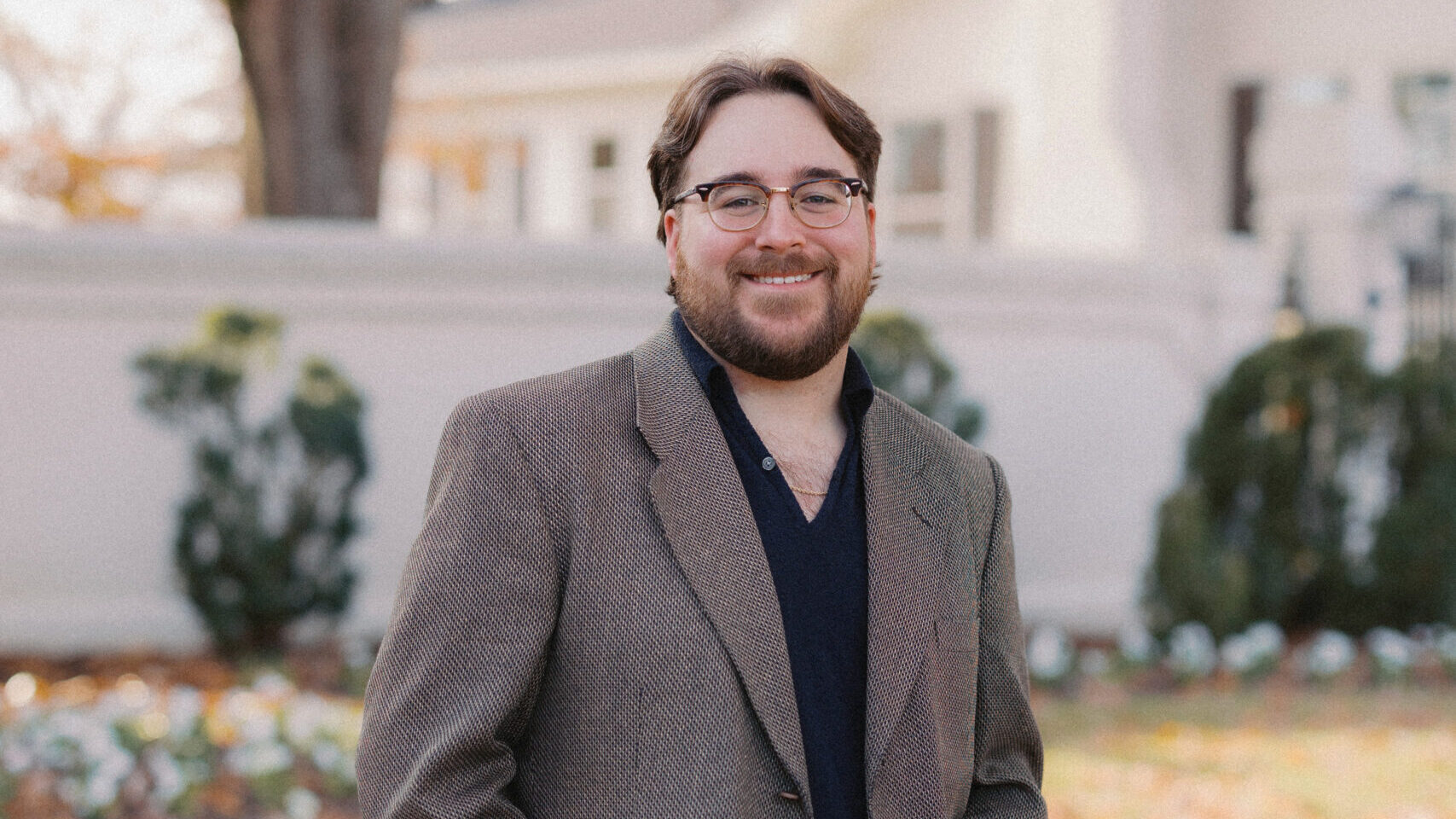
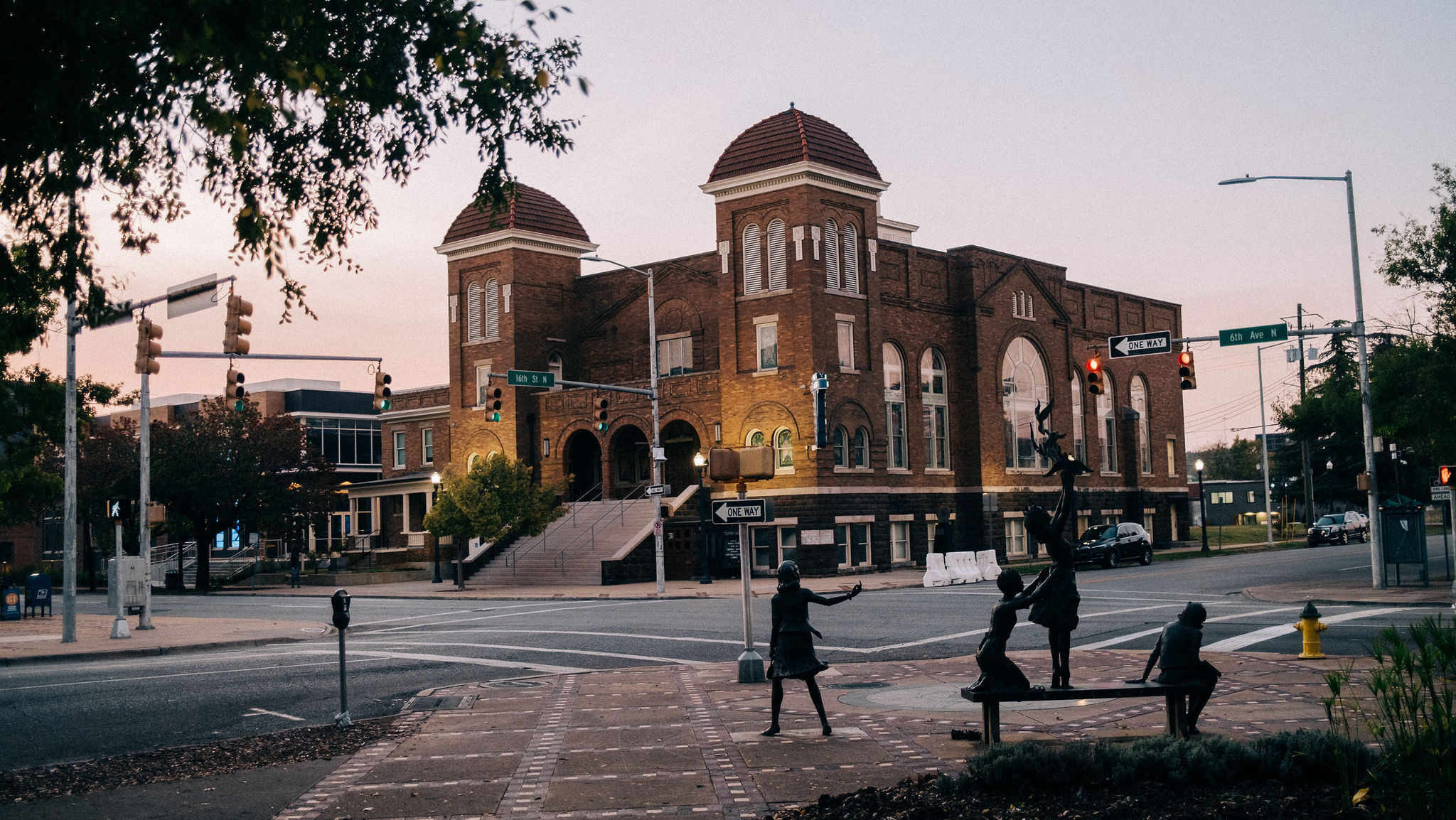
I meet Tyler Jones on this corner. Jones is the founder and director of 1504, an Emmy-nominated storytelling studio, and the creator of The Sacred Ordinary exhibit. At the corner where we stand, four young girls—Denise McNair, Addie Mae Collins, Cynthia Wesley, and Carole Robertson—are immortalized in bronze and steel, dressed in their Sunday best, reaching skyward toward the doves above.
In the presence of the past
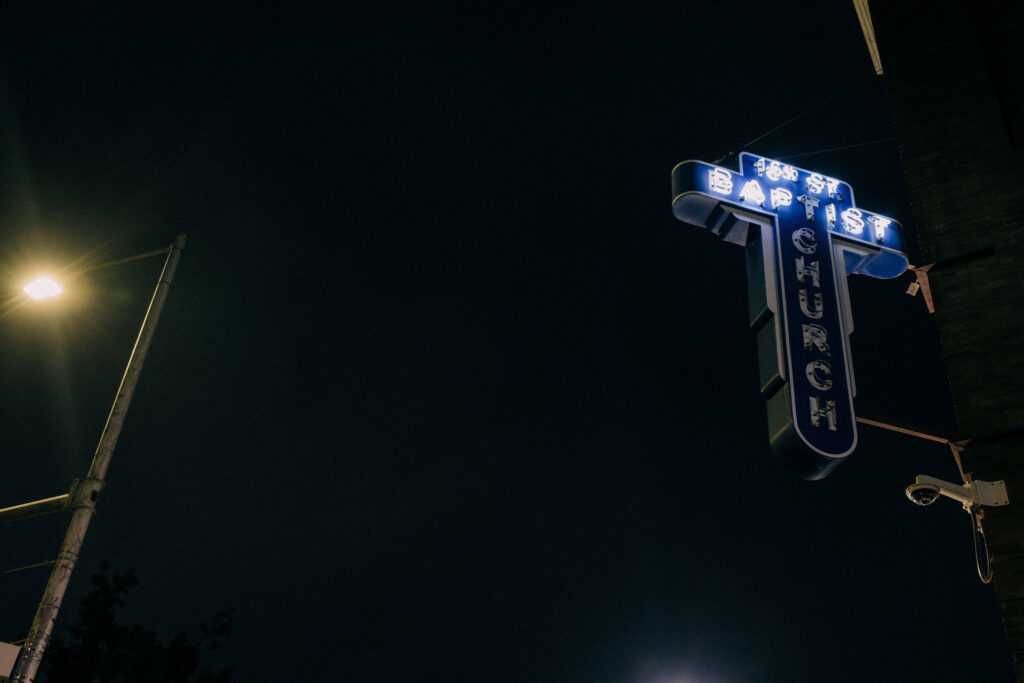
I immediately understand why Jones chose this place as the starting point for The Sacred Ordinary, a public art installation that brings light and life to our city’s history. So much of that history unfolded on this very block, and much of it is preserved here. Across the street stands the Birmingham Civil Rights Institute, and just diagonally from where I stand is 16th Street Baptist Church, where the four girls were killed in the bombing on September 15, 1963.
The Sacred Ordinary is self-guided, but Jones provides context for how and why the installation came to be. A fellow Birmingham native, he hopes to preserve not only the stories of the Civil Rights Movement but also the memory of the physical spaces where they unfolded—particularly as historic markers and signage deteriorate, and the movement’s foot soldiers pass away.
(Courtesy of 1504)
“I love Birmingham,” Jones tells me. “I want my children to grow up knowing the stories of the brave and resilient people who came before them, especially the children who made tremendous sacrifices for a greater cause.”
The decision to create a nighttime experience was intentional, too. “Most people don’t know what this space is like at night,” he says. Looking around, I agree. The streets are calm, quiet. There is something almost holy about the stillness.
Sacred spaces
I begin by texting the number provided, and the experience opens with the resonant voice of actor and Bessemer native Andre Holland, reading these words by Wendell Berry: “There are no unsacred places; there are only sacred places and desecrated places.”
The recording continues: “Places, like history, are always changing. What we choose to preserve reflects what we value.”
What places, objects, and memories do we choose to preserve, and who takes responsibility for keeping them alive? For Jones, that responsibility is never passive. Each generation must make a conscious choice to carry these stories forward.
“I believe every generation has to choose to keep these stories alive,” he says. “That responsibility feels especially urgent as more of the eyewitnesses to the Civil Rights Movement pass away.”
It is a shared responsibility, one that asks something of everyone. We often learn about the Civil Rights Movement through its icons and defining moments. Those stories matter, but they don’t tell the whole story. To focus only on a handful of names and events is like tearing a page from a novel and expecting to understand the entire book. The installation gives breath and movement to the larger picture: the communities, unsung heroes, and ordinary people who found the courage to seek justice in an uncertain world.
The experience is deliberately reflective. There aren’t pages of signage, dates, or inscriptions to read. Instead, the installation asks visitors to pay attention to the spaces themselves.
“Give yourself permission to move slowly,” Holland says in the recording. “Notice what is here, and what is missing.”
(Courtesy of 1504)
A city of stories
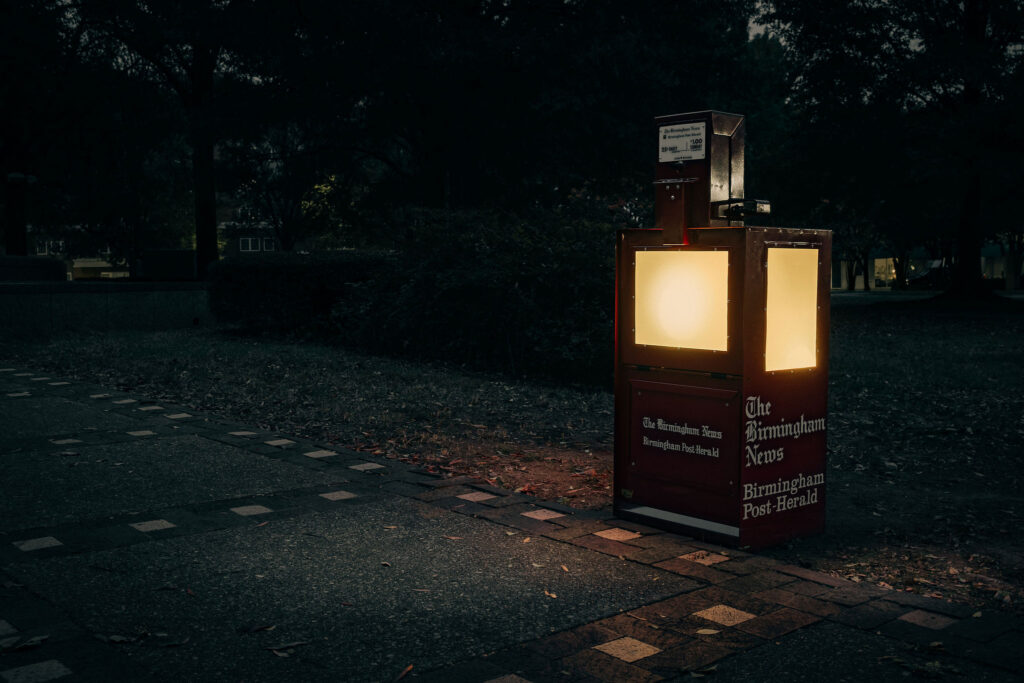
I begin in Kelly Ingram Park, where I immediately spot an old Birmingham News vending machine, illuminated from within by a warm yellow glow. There is nothing to read at this stop; I’m simply asked to take in my surroundings. Quiet and intentionally set apart from the noise of the day, the nighttime experience creates room to consider the sacred history here—both what remains and what has been lost.
The installation is easy to follow. Visitors can take their time at each stop, texting the next prompt when they’re ready to move on. And the experience extends beyond the park, leading visitors through the surrounding Civil Rights District and offering context for the places they encounter along the way. Rather than simply reading about history, you begin to understand it in relation to the ground beneath your feet.
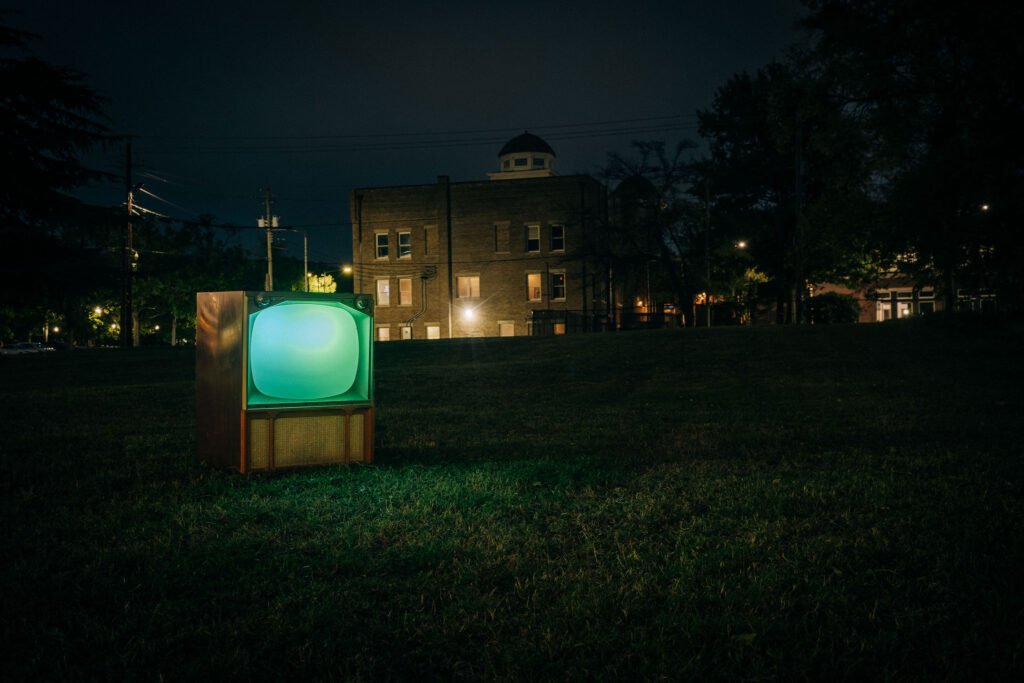
Eventually, we turn onto 7th Avenue and approach an empty lot where a house once stood. All that remains are the stone steps leading to the porch. Within the outline of an otherwise invisible living room sits an old television, glowing a neon green.
(Courtesy of 1504)
The scene feels ghostly, almost otherworldly. I imagine a family gathered there on an ordinary evening, watching television, leaning their heads against one another. I imagine the conversations after dinner and children arguing over dessert. The ordinary rhythms of everyday life, the moments that give a place its meaning.
Here, the absence of a home becomes a reminder of what once filled it. The installation asks us to consider not only the history we can see and document, but also the lives and the memories that have taken shape in these spaces.
The work of remembering
“Where do you feel a sense of place most strongly? What changes when we encounter history this way?” Holland asks.
Certainly, we encounter our city’s history here in ways that are revealing, and sometimes even startling. The installation asks something of its participants: to do more than read history from a page, but to walk the sidewalks where ordinary people made extraordinary sacrifices, to stand in the places they once stood, and to listen.
“I hope people who experience The Sacred Ordinary give themselves permission to slow down and be present,” Jones says. “And I hope they leave thinking about the places and stories in their own lives that deserve care.”
There are stories we inherit, stories we discover, and stories we have a responsibility to carry forward. The Sacred Ordinary asks us to consider all three, beginning with where we stand.
The work remains unfinished. It’s up to us to continue telling the stories, to keep them alive.
(Courtesy of 1504)
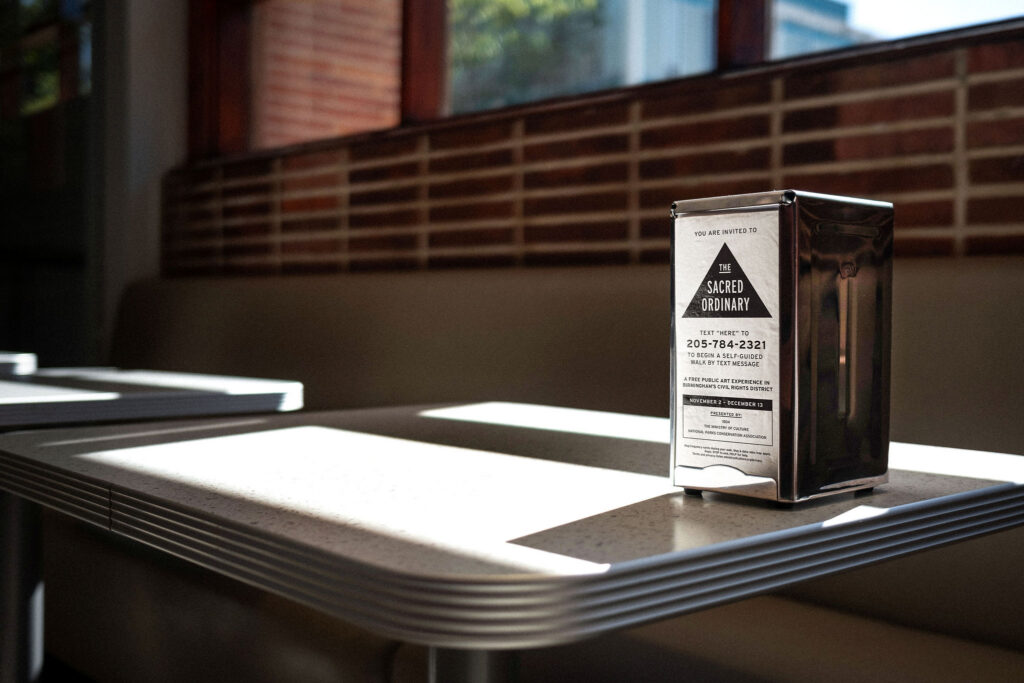
The Sacred Ordinary is presented by The Ministry of Culture in partnership with the National Parks Conservation Association. The free, self-guided nighttime installation is open nightly from 5 to 8 p.m. through December 13, 2026, in Birmingham’s Civil Rights District. To begin the experience, text HERE to 205-784-2321. Visitors can find additional information on their website.
Want more stories like this? Join our newsletter for more stories rooted in Alabama, delivered to your inbox every Friday.